
Housing Access Control for Safer Residential Schemes

A communal entrance that is difficult to manage can quickly become more than a security issue. It can affect residents' confidence, staff response, visitor management and the day-to-day running of a scheme. Effective housing access control gives housing providers a practical way to protect people and property without making a resident's home feel restrictive or impersonal.
For supported housing, independent living and residential care environments, the right approach is rarely a single door-entry panel or a replacement lock. It is a considered system that reflects who lives in the building, how the building operates and what must happen if there is an emergency, power loss or communication fault.
Why housing access control needs a resident-first approach
Access control in residential property has a different purpose from access control in a conventional office. A housing scheme may need to accommodate older residents, people with mobility limitations, visitors, carers, district nurses, maintenance teams and emergency services. Some residents will be comfortable using a key fob or proximity tag; others may need a simple door release handset, a clearly positioned push button or help from a support team.
Security measures that are technically effective can still fail in practice if they create confusion. A door that closes too quickly may be difficult for a wheelchair user. A video entry screen with small controls may not suit a resident with impaired sight. An entry process that depends on a smartphone may exclude people who do not use one or cannot reliably charge one.
The starting point should therefore be the resident journey. Consider how people enter their own home, receive family and healthcare visitors, leave the building independently and obtain help when something goes wrong. This places dignity and independence alongside security, rather than treating them as competing requirements.
What a well-planned housing access control system includes
A suitable system is usually made up of several connected decisions. The communal entrance is the obvious point, but side doors, staff entrances, bin stores, plant rooms, cycle stores and internal communal areas may all require different levels of control. There is no value in fitting a high-quality main entrance system if an unprotected secondary door is routinely left open.
Door entry equipment allows residents to identify and admit visitors from within their home. Depending on the scheme, this may be audio entry, video entry or a combination of both. Video can provide useful reassurance where residents are concerned about doorstep callers, although good lighting, a suitable camera position and a clear display are essential if the image is to be useful.
Credential-based access gives authorised residents, staff and contractors a controlled route through selected doors. Fobs, cards and proximity tags remain familiar, dependable options for many schemes. They can be issued, cancelled and replaced without changing the lock whenever a key is lost. Larger or higher-risk sites may also benefit from defined permissions, so that staff can access service areas while residents have access only to the areas relevant to them.
A system can also provide an audit trail showing when an authorised credential has been used. This can assist investigations following an incident, but it should be specified carefully. Housing providers need clear policies on who can view access records, why records are retained and how personal data is handled. An audit trail is useful evidence, not a substitute for sound site management.
The design decisions that prevent problems later
The most reliable installations begin with a site survey and a clear operating brief. Providers should map the building, identify all access points and establish where residents, staff and visitors are likely to need different routes. This is particularly important on older schemes, where extensions, altered entrances and historic cabling can create hidden constraints.
Door condition matters as much as the reader or intercom mounted beside it. The door, frame, hinges, closer, lock release and cabling must work together. A poorly aligned door can cause repeated release faults. A closer set too strongly can make entry difficult; set too weakly, it may leave the door insecure. These details are often the difference between a system that works on handover day and one that remains dependable after years of daily use.
Fire safety and means of escape must be considered from the outset. Access control must never prevent people from leaving safely in an emergency. The appropriate locking arrangement, emergency release, fire alarm interface and fail-safe or fail-secure behaviour will depend on the door's role, the building design and the fire strategy. This should be agreed with competent parties rather than assumed from a standard product specification.
Power and communications resilience also deserve close attention. Some systems rely on local power supplies, network connections or hosted services. Providers should understand what continues to operate during a power cut, what is supported by battery backup and how faults will be reported. Where an entrance system is associated with a carephone, warden call or telecare arrangement, the consequences of a communication failure need particular consideration.
Digital transition is an access control issue too
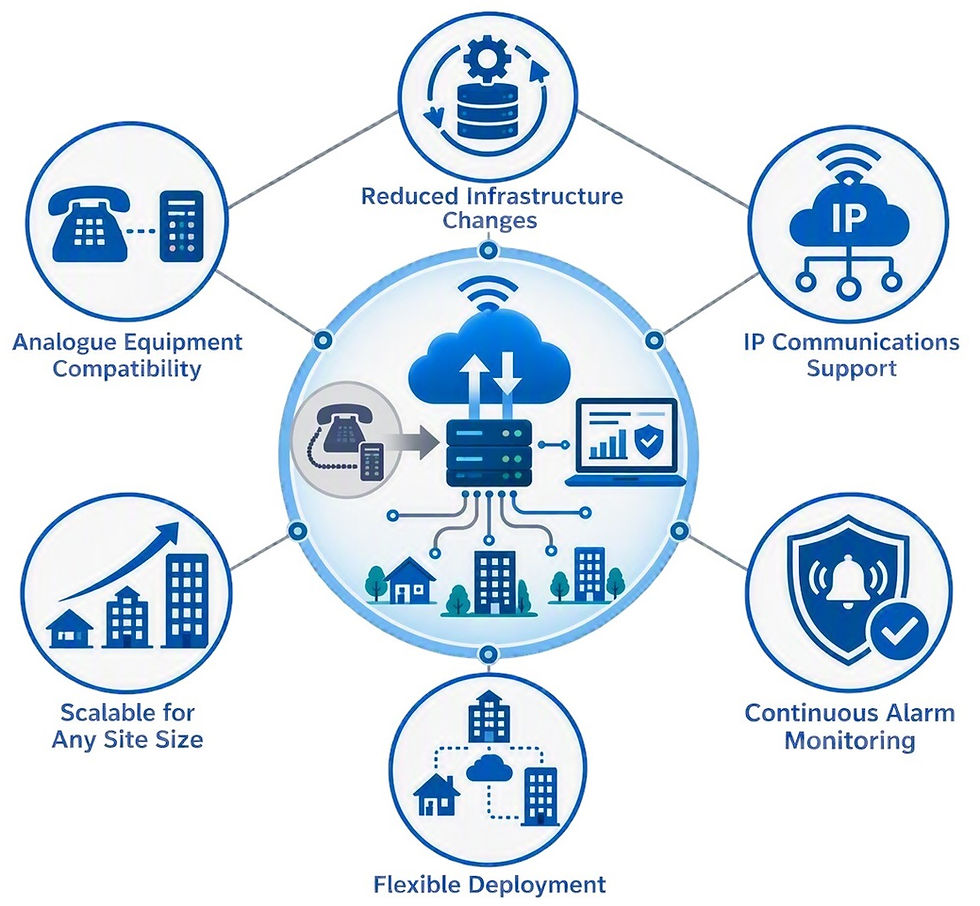
The BT Digital Switchover is changing the communications infrastructure used across many housing schemes. Analogue telephone lines that have supported legacy door entry, carephone and emergency call arrangements may no longer provide the expected service once moved to digital networks. Equipment that appears to be operating today may not be suitable for the new environment.
This does not mean every existing system must be removed immediately. In some cases, an upgrade path, interface or targeted replacement can extend useful service while a wider modernisation programme is planned. In others, ageing equipment, unsupported parts or unreliable cabling make full replacement the more responsible option. The right decision depends on condition, compatibility, resident needs and the future plans for the property.
A proper assessment should examine the complete communication path, not simply the panel at the entrance. That includes resident handsets, network equipment, power supplies, remote support arrangements and any integration with warden call or telecare services. Testing after migration is essential, especially for emergency calling and door release functions.
Choosing technology without over-specifying it
It is easy to specify more technology than a scheme can reasonably support. Mobile credentials, cloud administration and advanced visitor systems can be valuable in the right setting, particularly where staff work across multiple locations or access permissions change frequently. They also introduce new questions around mobile coverage, account management, cyber security and ongoing subscription costs.
For a small independent-living scheme, a clear audio or video entry system with managed fobs may be the most suitable answer. For a large mixed-use development, a centrally managed solution with access levels, event reporting and integration with other building systems may be justified. The objective is not to select the newest feature set. It is to provide a system that residents and staff can use confidently, and that the organisation can maintain over its full life.
Compatibility should be checked before connecting systems. Integrating door entry with warden call, telecare or reception arrangements can improve the resident experience, but each integration must be tested for normal use, fault conditions and emergency operation. A connected system should make responsibilities clearer, not create uncertainty about which supplier supports which element.
Installation, support and planned maintenance
Installation should be managed to minimise disruption, particularly in occupied schemes. Residents need clear information about access arrangements during works, how new credentials will be issued and who to contact if they cannot use the new equipment. Brief demonstrations can be more effective than lengthy written instructions, especially where an entry process has changed.
Handover should include accurate records of doors, equipment, credentials, programming and maintenance requirements. These records are valuable when staff change, an incident occurs or further works are planned. They also help prevent an all-too-common problem: a system that nobody feels able to administer after the original installer has left.
Planned maintenance is not simply a service visit for the panel. It should cover the physical doors, locking hardware, releases, intercom call quality, power supplies, batteries and relevant interfaces. Regular checks can identify wear before it affects security or resident access. For older equipment, component repairs may offer a sensible way to preserve service continuity while a replacement programme is developed.
Network Communication Systems Limited supports providers across access control, door entry, warden call, telecare and digital-transition requirements. That wider view matters where resident safety and communications depend on systems working together, rather than as isolated installations.
A practical route to a better scheme
Before committing to a replacement or upgrade, gather evidence from the people who use the building every day. Review recurring faults, incidents of unauthorised entry, lost-key costs, resident feedback, staff access requirements and the condition of existing communications infrastructure. This provides a stronger basis for investment than selecting equipment from a feature list.
Then set out what good operation looks like: residents can enter and leave safely, genuine visitors can be admitted easily, staff access is controlled, emergency egress is protected and faults receive a defined response. With those outcomes agreed, the technology choice becomes clearer. The best housing access control system is one residents barely have to think about - because it supports a safer, more confident place to live every day.


Comments