
Access Control for Housing Schemes That Works

A communal entrance that does not close properly, a lost fob that remains active, or an unclear visitor process can quickly become more than a facilities issue. For supported and independent living providers, access control for housing schemes is part of the wider duty to protect residents, staff and visitors while preserving the dignity and freedom of people’s homes.
The right arrangement is rarely just a keypad on a door. It must reflect who lives in the scheme, how the building is used, the support available on site and the systems already in place. A well-planned solution gives authorised people straightforward access, creates appropriate control at shared entrances and provides housing teams with a clear way to manage changes over time.
What access control needs to achieve in housing schemes
Housing schemes have different pressures from a conventional office or commercial site. Residents may have visitors, carers, delivery drivers, contractors and emergency services arriving throughout the day. Some residents may be living with dementia, reduced mobility, sensory impairment or limited confidence with technology. Staff may need to enter individual areas quickly, while communal spaces require sensible controls without making a building feel institutional.
The objective is therefore balanced access, not maximum restriction. Residents should be able to come and go with confidence. Authorised visitors should be admitted through an understood process. Unauthorised entry should be made more difficult, and staff should be able to investigate concerns without relying on guesswork.
A properly specified system can support this through managed credentials, controlled doors, door-entry communication and recorded events. It also makes routine administration more reliable. When a resident moves, a staff member leaves or a contractor’s work finishes, their access can be changed without recovering and replacing every physical key.
Start with the people, doors and daily routines
Before selecting equipment, map the scheme’s normal patterns of movement. This means more than counting doors. Consider the main pedestrian entrance, secondary entrances, gates, bin stores, plant rooms, mobility-scooter areas, staff spaces and internal communal rooms. Identify which doors need access control, which need door entry, and which must remain freely available for safe escape.
It is equally useful to establish who needs access and when. A development with a daytime scheme manager has different requirements from a 24-hour supported-living setting. A sheltered housing scheme may need an easy visitor calling process and clear resident communication, whereas a higher-support environment may require greater staff oversight at particular entrances.
This early assessment prevents a common problem: fitting a technically capable system that does not match the way residents and teams actually use the building.
Choosing access control for housing schemes
Credentials should be selected for usability as much as security. Proximity fobs and cards are familiar, quick to use and straightforward to issue or cancel. They can work well where residents need simple, repeatable access to communal entrances. PIN pads may suit selected staff-only areas, but codes can be forgotten, shared or observed, so they are rarely the best single answer for a main resident entrance.
Mobile credentials can reduce the need for physical tokens and may help staff teams manage access across several sites. However, they are not suitable as the only method where residents do not have, or do not wish to use, a compatible smartphone. Housing providers should avoid assuming that newer technology is automatically more inclusive.
Door entry should be considered alongside the access control system. Audio or video door entry lets residents or staff identify a caller before releasing the door. In many schemes, this provides a more appropriate visitor experience than giving a shared code or expecting residents to travel to the entrance. The specification should account for hearing, vision and mobility needs, including clearly positioned panels, suitable audio levels and controls that can be used without unnecessary dexterity.
Controlled access does not replace a safe door
Electronic control is only as dependable as the door, locking hardware and installation around it. A warped door, poorly aligned lock or weak closer can lead to repeated faults and compromised security, whatever reader is fitted to the wall. The door must close and latch consistently, while the locking arrangement must suit the door type, expected traffic and fire strategy.
Fire safety is particularly important. Access-controlled doors on escape routes need to release correctly when required, in accordance with the building’s fire-risk assessment and relevant design requirements. This is a specialist area, not a detail to leave until commissioning. Emergency egress, fire-alarm interfaces, break-glass units and local door releases must be agreed as part of the system design.
Build a system that is manageable after installation
The best access control systems make daily administration simpler. Housing teams should be able to add, remove and amend access permissions without waiting for a site-wide lock change. Yet convenience must not create weak processes. Responsibility for enrolment, approval and cancellation should be clear, particularly where staff, agency workers and contractors are involved.
A practical permissions structure often reflects roles rather than individuals. Residents may have access to the main entrance and relevant communal areas. Maintenance staff may have time-limited access to plant rooms. Care or support teams may need wider permissions, with arrangements that align with care plans and operational procedures. The precise model depends on the scheme, but permissions should be reviewed regularly rather than accumulating indefinitely.
Event records can help resolve incidents, such as a door being held open or a credential being used outside normal hours. They should be treated carefully. Access records may contain personal data, so providers need clear retention periods, appropriate user permissions and a lawful, proportionate reason for collecting the information. A system should support good governance, not create an unnecessary pool of sensitive data.
For larger estates, a central management platform can bring several buildings into one controlled view. This can improve consistency and reduce travel for routine changes. The trade-off is that the platform, network and support arrangements become more significant. Providers should ask how the system performs if connectivity is lost, how local doors behave, and who can provide technical assistance when an urgent issue occurs.
Plan for faults, power loss and urgent access
Access control is part of a live residential environment. It needs a response plan, not only an installation certificate. Decisions should be made in advance about power resilience, battery backup, manual overrides, replacement credentials and out-of-hours support. The right approach will depend on the building and risk assessment, but there should always be a safe, documented route for residents and authorised staff when a component fails.
Maintenance matters too. Readers, locks, closers, intercom handsets and exit devices all experience heavy daily use. Periodic inspection identifies worn components before they become a repeated cause of call-outs or a barrier to entry. Keeping a record of faults also helps distinguish an isolated damaged fob from a recurring issue with the door or lock.
Connect access with the wider resident safety system
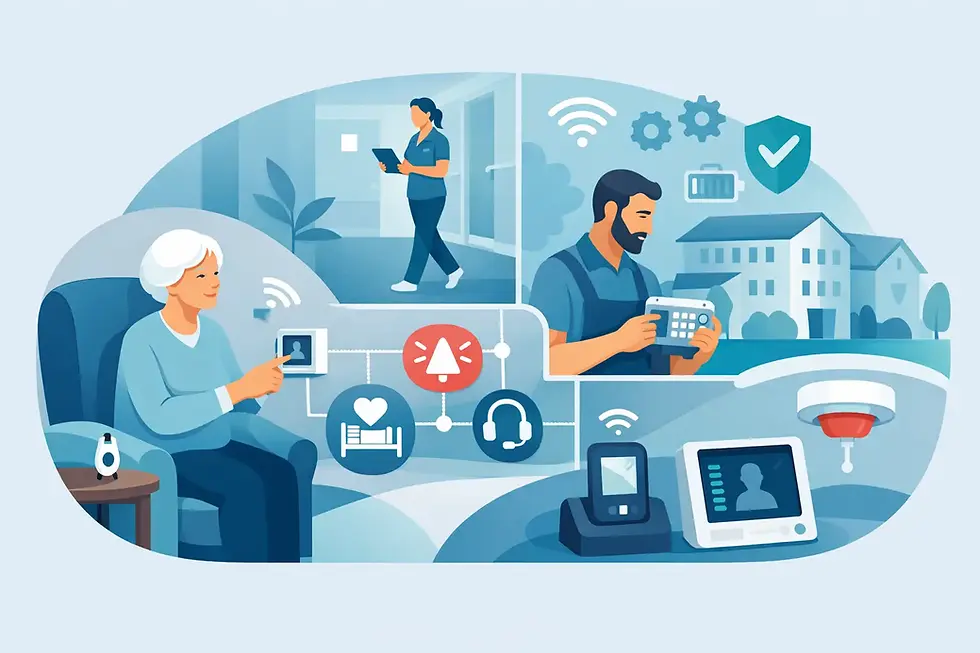
For supported housing, entrances cannot always be considered in isolation. Door entry, warden call, telecare and carephone arrangements may all affect how staff respond to residents and visitors. A resident may need to speak with a caller at the entrance, request assistance after a door-related concern, or receive support when they cannot reach an entry handset.
Integration should only be introduced where it provides a clear operational benefit. Connecting systems can improve response and reduce duplicated equipment, but it also requires careful design, testing and support. Staff need to understand what happens when an alert is raised, when a door is released and when communication equipment is unavailable.
The BT Digital Switchover makes this planning more pressing. Older analogue-dependent door entry, call and telecare equipment may not perform as expected on digital services or through network changes. Reviewing access arrangements at the same time as wider communication infrastructure can prevent a piecemeal upgrade and give providers a clearer route towards dependable digital operation.
Specify for the scheme you operate, not the brochure
A lower-risk independent-living block may need a simple, well-maintained fob and door-entry arrangement. A supported-living service with staff on site, vulnerable residents and multiple controlled areas may need a more detailed permissions model, integrated communication and stronger resilience. Neither approach is inherently better. The appropriate level of control follows the building’s use, resident needs and assessed risks.
Network Communication Systems Limited can support this wider view, combining door entry and access technologies with the communication and safety systems that housing providers already rely on. The value lies in creating an arrangement that can be maintained, understood and adapted as the scheme changes.
Before approving a specification, walk the resident journey from pavement to front door, then repeat it as a visitor, a night worker and an emergency responder. The points where each journey becomes confusing, delayed or insecure are usually the places where a better access-control decision begins.
https://www.netcomsysltd.com/access-control


Comments