
Best Access Systems for Flats and Residents

A flat entrance is rarely just a door. For a housing provider or supported-living operator, it is the point where resident safety, visitor management, emergency access and day-to-day confidence meet. The best access systems for flats therefore do more than prevent unauthorised entry. They must work reliably for residents with different needs, give staff appropriate control, and remain supportable as analogue services are withdrawn.
The right choice depends on the building, the resident group and the way the scheme is managed. A small block of general-needs flats has different requirements from extra care housing, supported living or a large mixed-tenure development. Starting with the operational need, rather than a preferred piece of hardware, produces a more dependable outcome.
Start with the resident journey
Before specifying readers, panels or credentials, consider how people use the building. Residents may arrive on foot, use mobility equipment, receive regular care visits, or need family members and approved contractors to gain entry. Staff may need access across several schemes, while emergency services need a clear, controlled route into the building.
This is particularly important in schemes supporting older people or residents with disabilities. A system that is secure but difficult to hear, reach, see or operate can create a barrier to independent living. Entrance panels should be positioned at a practical height, offer clear audio, and have controls that can be used by people with limited dexterity. Internal handsets or video monitors should be straightforward enough to use without repeated assistance.
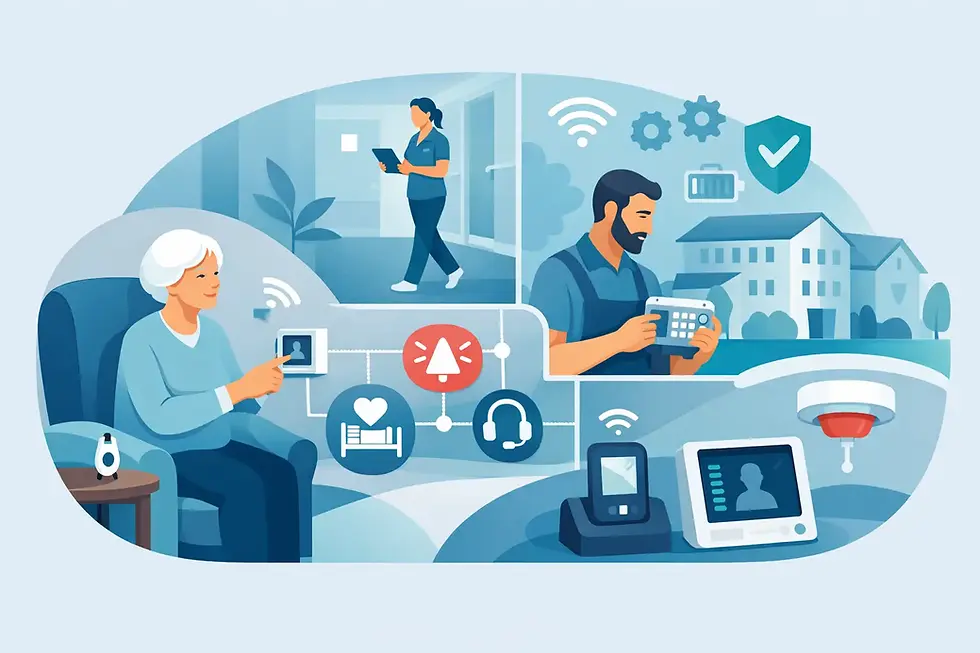
The access system also needs to fit alongside warden call and telecare arrangements. If a resident is expecting a care worker, for example, the access process should not create unnecessary delay or uncertainty. Where systems are connected, the design must make clear what happens during an alarm, a power interruption or a communications fault.
The main access systems for flats
There is no single best technology for every residential scheme. Most successful installations combine a communal entrance solution with credentials for residents and managed access for staff or visitors.
Audio door entry
Audio door entry remains a practical option for many existing blocks and lower-complexity schemes. A visitor calls a flat from the entrance panel and the resident speaks to them through an internal handset before releasing the door.
Its strengths are familiarity, relatively simple operation and lower upfront cost. It can be suitable where the entrance is clearly visible from nearby homes or where residents prefer a conventional handset. The limitation is that an audio conversation does not allow a resident to verify a caller visually. In busy urban locations or buildings with frequent deliveries, that may not provide enough reassurance.
Video door entry
Video door entry adds a camera at the entrance panel and a screen within each flat, allowing residents to see who is calling before granting access. This is often a strong choice for developments where visitor verification is a priority, including supported housing and new-build flat schemes.
Video can improve confidence for residents who are wary of opening the door to unknown callers. It can also help staff identify visitors, though the image quality, lighting and camera placement must be specified properly. A poor image at night is not a security improvement. Providers should also consider how video data is handled and whether any recording function is necessary, proportionate and managed in line with data-protection responsibilities.
Proximity fobs and cards
Proximity fobs and cards allow residents and staff to present a credential to a reader instead of using a physical key. They are convenient, can be cancelled when lost, and remove the cost and disruption of changing locks after a key goes missing.
For managed schemes, credentials offer useful control. A staff fob can be configured for shared areas, plant rooms and selected flats where authorised, while a resident fob can be limited to the entrances relevant to their home. The practical issue is administration. Someone must issue, record, replace and disable credentials promptly. Without a clear process, the control benefits are weakened.
PIN and keypad entry
Keypads can provide a useful additional route of entry for staff, regular visitors or contractors. They should not normally be the only method of access for a residential entrance. Shared codes can be passed on, observed or retained by people who no longer need access.
Where PIN access is used, codes should be individual or role-based where possible, changed when staffing arrangements alter, and never treated as a substitute for proper credential management. A keypad is most effective as part of a wider access-control policy rather than a stand-alone answer.
Mobile and cloud-managed access
Mobile credentials can allow authorised users to open doors using a smartphone. Cloud-managed platforms can give housing teams central control of permissions across sites, which is useful for dispersed supported-living services or portfolios with mobile maintenance teams.
These systems can reduce the need to issue physical fobs and make permissions easier to amend. They do, however, rely on sound digital infrastructure, a clear approach to cyber security and workable alternatives for residents who do not have, or do not wish to use, a smartphone. Mobile access should widen choice, not exclude people.
Access control should protect without obstructing
A secure entrance door is only one part of a safe system. The locking arrangement, door closer, fire strategy, emergency override and accessibility features must work together. In particular, electrically controlled doors must release correctly in a fire or emergency condition where required by the building design and relevant standards.
Door release times also matter. A short release may suit a compact entrance, but could be unsuitable for someone using a wheelchair, walking frame or mobility scooter. Conversely, a door held open for too long increases the opportunity for tailgating. This is a detail that should be tested on site with the people who will use the entrance every day.
Communal doors should be assessed for condition as well as electronics. A high-quality reader cannot compensate for a warped door, failing closer, damaged frame or poorly adjusted lock. Planned maintenance needs to cover both the access equipment and the physical door environment.
Plan for visitors, deliveries and emergencies
Visitor access is often where a well-intended system becomes inconvenient. Residents need to admit family, carers and legitimate deliveries without feeling pressured to release the door to an unknown caller. Clear entrance-panel labelling, reliable call routing and good audio or video quality make a material difference.
For supported housing, regular care providers may need time-limited or auditable access. This should be agreed with the operator, residents and care teams, with permissions matched to the care plan and safeguarding requirements. A master key held informally by several people is difficult to control and difficult to investigate.
Emergency access should be documented and tested. Housing teams should know who can authorise access outside normal hours, how a system fault is reported, and what alternative arrangements apply if the primary communications path is unavailable. These are not administrative details. They are part of service continuity.
Choose digital systems with a transition plan
The BT Digital Switchover is a decisive factor for older door-entry, warden-call and telecare installations. Equipment that once relied on analogue telephone lines may not behave as expected when connected through digital services. Calling functions, alarm paths, power resilience and compatibility all need review before migration, not after a resident experiences a failure.
A survey should identify existing equipment, communications routes, power supplies, door hardware and interfaces with other safety systems. It should then establish whether the existing system can be adapted, requires an interface, or should be replaced with a purpose-designed digital solution. Retaining a legacy system can sometimes be sensible where it is serviceable and supported. In other cases, investing in a modern platform avoids repeated short-term fixes and gives a clearer path for future expansion.
The best access systems for flats are therefore not selected on feature lists alone. They are specified for the building's communications infrastructure, resident needs and long-term support arrangements. Ask how faults will be diagnosed, whether replacement parts remain available, and what happens when a resident's handset, fob or entrance panel fails.
Procurement questions that prevent future problems
When comparing proposals, look beyond the initial equipment price. Confirm who will survey the site, install the system, commission it, train staff and residents, and provide support after handover. Clarify ownership of system administration, credential records and any cloud platform. It is also worth asking how the design will accommodate future flats, additional doors or changing care arrangements.
Network Communication Systems Limited supports this whole-life approach across door entry, access control, Warden Call, telecare and Digital Transition. The objective is not simply to fit a new panel at the entrance, but to provide a system that continues to serve residents and operational teams reliably.
A well-chosen access system should feel uncomplicated to the people who depend on it. When security, accessibility, digital resilience and responsive support are considered together, the entrance becomes a dependable part of independent and supported living rather than a daily point of friction.


Comments