
Carephone Replacement After Line Closure

A carephone replacement after line closure is not simply a matter of fitting a new telephone unit. For supported housing and care providers, the existing carephone may be the point through which residents raise an emergency alarm, staff communicate with a scheme, door entry calls are handled and telecare alerts reach a response service. The replacement project must protect each of those functions from the first survey to post-installation testing.
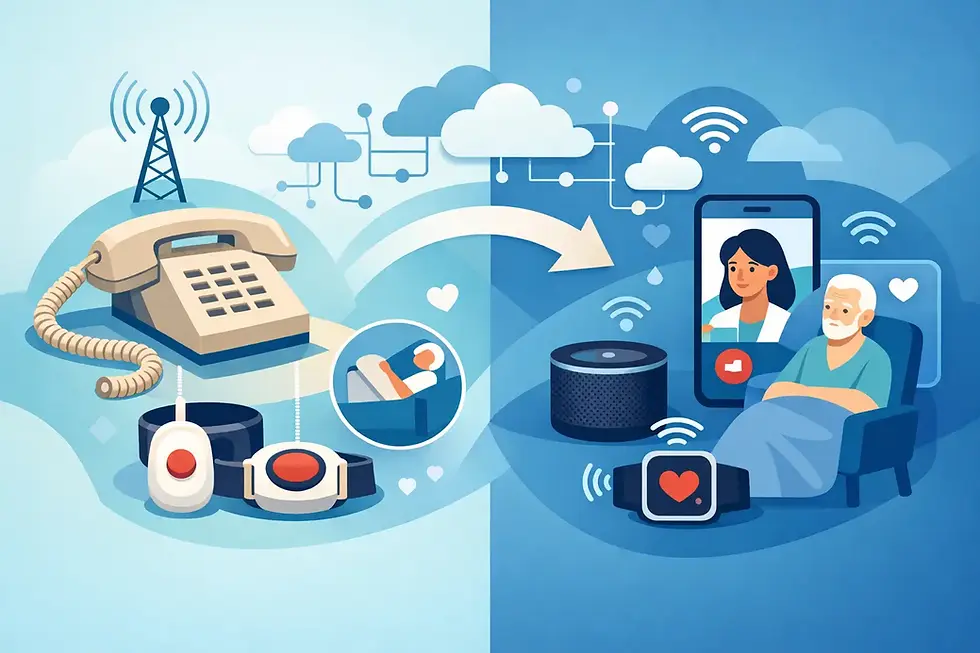
Traditional telephone services were designed around a powered copper line. Digital voice services operate differently, usually using broadband connectivity and local mains power. That change can affect call quality, alarm signalling, backup arrangements and the way a resident receives help during a power or connectivity outage. A planned replacement therefore needs to be led by resident safety and service continuity, rather than by the availability of a single substitute handset.
Why carephone replacement after line closure needs planning
Carephones are often part of a wider scheme infrastructure. A unit in an individual flat may connect to communal equipment, a warden call system, a monitoring centre, door-entry panels, pull cords, smoke detectors or radio telecare peripherals. Some systems also support welfare calls, out-of-hours communication and programmed call routing.
Replacing the carephone without confirming these connections can create a hidden gap. The device may be able to make an ordinary voice call but fail to pass a pendant alarm reliably, identify the correct dwelling, activate the right response path or maintain operation during a local power failure.
The right approach depends on the building and the service model. A small independent-living scheme with a monitored dispersed alarm service has different requirements from a large sheltered housing development with onsite staff, communal door entry and central control equipment. In both cases, the objective is the same: residents must retain a clear, dependable route to assistance.
Start with a system and resident impact survey
Before selecting equipment, establish what is installed, how it communicates and who relies on it. This should cover every carephone location, communal panel and connected alarm device, not only the line identified for closure.
Identify the existing pathways
Record the incoming and outgoing call arrangements, the receiving alarm centre or nominated contacts, and any dependencies on analogue line features. Confirm whether the equipment sends speech, alarm tones, digital alarm protocols or a combination of these. Older systems can use signalling methods that are not suitable for every digital voice connection or analogue telephone adaptor.
The survey should also identify related building systems. Door entry is a common example. If residents use the carephone to speak to a visitor and release a door, that function must be tested as part of the migration. The same applies to communal fire interfaces, lift telephones, emergency call points and staff handsets where they are connected to the wider communication system.
Understand individual resident needs
A technical audit is only half the work. Housing and care teams should identify residents who may be particularly affected by a change in equipment or calling routine. This can include people with hearing loss, sight loss, reduced dexterity, cognitive impairment, limited English or a high dependency on regular welfare contact.
Where a resident uses a pendant, falls detector, smoke alarm, epilepsy sensor or other telecare peripheral, check the compatibility of every item with the proposed digital solution. Reusing peripherals can reduce disruption and cost, but only where their radio protocol, battery condition and alarm reporting have been properly verified. In other cases, replacing and recommissioning the full set is the safer course.
Choose a replacement architecture, not just a device
The replacement should be specified around the required outcome. In a scheme setting, that may mean a digital warden call system with speech capability, alarm routing, local or remote configuration and a clear route to a monitoring service. In dispersed accommodation, it may mean a digital telecare unit designed for the resident's home, with appropriate mobile or IP connectivity.
A digital system can provide useful operational improvements, such as clearer alarm identification, remote diagnostics, more flexible call routing and support for modern telecare protocols. However, these benefits only count when the communications path, monitoring arrangements and support responsibilities are defined from the outset.
Do not assume that an adaptor allowing an analogue device to plug into a router is a long-term solution. It can be appropriate in limited circumstances, following successful end-to-end testing, but it may not provide the resilience, alarm compatibility or management capability required for a critical resident safety service. It can also leave an ageing carephone in place when its components, batteries and peripheral support are already nearing end of life.
For many providers, the line closure is the point at which a wider modernisation becomes sensible. This might combine Warden Call, telecare and door entry planning rather than treating each system as an isolated asset. The scope should remain proportionate. A sound replacement for one small scheme need not become an unnecessary estate-wide redesign, but it should not introduce a short-lived compromise either.
Build resilience into the digital carephone replacement
An analogue line traditionally supplied power from the exchange. Digital equipment commonly depends on electricity within the dwelling or communal area, as well as a live network connection. The impact of a power cut must therefore be considered explicitly.
Specify appropriate battery backup for the carephone, router or communications equipment, and any essential local control equipment. The required duration should be based on the risk assessment, the resident group, likely outage arrangements and the service provider's response model. A battery is not a guarantee by itself: it must be sized correctly, monitored where possible and included in a replacement programme.
Connectivity also needs a fallback plan. Depending on the solution, this may involve mobile connectivity, dual-path communications or a managed route with fault monitoring. Mobile coverage should be checked at the actual installation location, including ground-floor flats, internal cupboards and plant rooms. A strong signal outside the building does not necessarily prove reliable indoor operation.
Resilience has a practical human element too. Residents and staff need to know what will happen during an outage and how to seek help if a device indicates a fault. Clear instructions, accessible formats and a contact route for reporting concerns are part of the system design.
Manage installation as a live safety-critical change
A phased installation programme reduces risk. Agree the order of works, resident appointments, access procedures and temporary arrangements before equipment is removed. In higher-risk cases, a resident should not be left without an operational alarm route while a change is being completed.
Each installation should include more than a dial-tone check. Test the alarm activation, speech connection, resident and property identification, call routing, response handling and any linked peripherals. Test door entry and other connected functions where relevant. Record the results against the individual property or device so that there is a clear commissioning record.
The receiving monitoring service must be involved early. It needs the correct device identifiers, resident details, escalation contacts and agreed response instructions before the new unit goes live. A technically successful alarm that arrives with incomplete information can still delay an effective response.
Communication with residents should be direct and reassuring. Explain why the work is taking place, what will happen in the home, whether they need to be present and how the new equipment will be used. Demonstration matters, particularly where a resident is accustomed to a familiar carephone layout or has relied on the same pendant for many years.
Specify for support, testing and future change
Procurement should assess the whole service life, not only the installed price. Ask who will provide fault diagnosis, component repairs, replacement batteries, configuration changes and onsite support. Establish whether equipment can be monitored remotely and whether the supplier can support both legacy equipment during transition and the new digital system afterwards.
Good documentation makes future maintenance safer and faster. Keep current device records, configuration details, battery schedules, alarm-routing information and test certificates. Facilities and housing teams should also have a straightforward process for reporting faults, notifying changes in resident circumstances and arranging replacement peripherals.
Network Communication Systems Limited supports this type of transition through specialist digital communication, telecare, Warden Call and component repair services. The value of specialist support is not simply the equipment supplied. It is the ability to understand the operating environment, test the critical pathways and keep a resident safety system serviceable after installation.
A line closure can be the prompt to replace ageing carephones, but the most useful outcome is a service that is easier to support and better prepared for the years ahead. Begin with the resident journey from alarm activation to response, then make every technical decision serve that journey.


Comments