
Communal Housing Emergency Call Systems Explained

Updated: 5 days ago
A resident presses a call point after a fall in a shared corridor. Another needs reassurance overnight in their flat. In both cases, communal housing emergency call systems must do more than make a sound: they must identify where help is needed, alert the right person or monitoring service, and continue operating when conditions are far from ideal.
For housing providers and supported-living operators, the system is part of the building's safety infrastructure. Its suitability depends on the residents, the layout, staffing arrangements, and the response plan behind it. Choosing equipment without defining those operational needs can create costly gaps later, particularly as analogue telephone services are withdrawn.
Understanding Communal Housing Emergency Call Systems
A communal emergency call system connects residents and shared spaces to a defined source of help. Depending on the scheme, this may be an on-site warden, a concierge, a staff team, a call handling centre, or an approved out-of-hours responder. The essential purpose is simple: make it possible to request assistance quickly, from the right location, with enough information for an effective response.
A typical installation may include a central control unit, resident speech units or carephones, portable pendants, pull cords, wall-mounted call points, door-entry integration, and communication pathways to an alarm receiving centre. The design can also accommodate specialist telecare peripherals, such as fall detectors, smoke alarms, flood detectors, and carbon monoxide detectors.
The technology is only one part of the service. A pendant alarm is of limited value if no one knows which resident is calling, whether two-way speech is available, or who has responsibility for attending. Good system design, therefore, joins equipment, connectivity, and response procedures into one dependable arrangement.
Importance of Communal Areas
Risks do not stop at a resident's front door. Lounges, laundry rooms, lifts, corridors, gardens, and entrance areas may all require a means of summoning assistance, depending on the scheme and resident profile. A call point in a shared area should provide clear location information, be easy to reach, and be positioned so it can be used after a slip, trip, or sudden illness.
There is a balance to strike. Adding devices everywhere may increase costs, maintenance needs, and the likelihood of accidental activations. Conversely, relying solely on personal pendants assumes residents will wear them consistently and can activate them when required. A site survey and a discussion with residents and staff will normally reveal where fixed call points add meaningful protection.
Starting with the Response Plan
The strongest specifications begin with a practical question: what happens in the first minute after an alarm is raised? The answer determines the required system features.
In a staffed scheme, an alarm may need to display on a local panel, activate a pager or staff handset, and show the caller's location. In an unstaffed independent-living scheme, it may route to a 24-hour monitoring centre with two-way speech. Some sites require both, with local staff responding during agreed hours and a monitoring service covering the remainder.
Before selecting a solution, establish:
Who receives alarms during the day, overnight, and at weekends.
How the responder confirms the resident's identity and location.
Whether two-way speech is required in flats and communal areas.
Expected response times and escalation where there is no answer.
How access will be gained if a resident cannot open the door.
Who tests, records, and maintains the equipment.
These decisions influence everything from call routing and equipment locations to door-entry integration. For example, a call handling centre may be able to speak to a resident but still require a clear arrangement for keyholding, emergency access, or attendance by local staff.
Recognising Individual Resident Needs
Communal housing is rarely uniform. One resident may benefit from a simple pendant and clear speech unit, while another may need a sensory alarm, a large-button call device, or an automatic detector. Language, hearing, mobility, cognition, and confidence with technology should all inform the assessment.
The answer is not to over-specify every flat. It is to choose a system platform that supports appropriate individual equipment without making future changes difficult. Flexible telecare provision is particularly valuable where tenancies change regularly or needs increase over time.
Navigating the Digital Transition
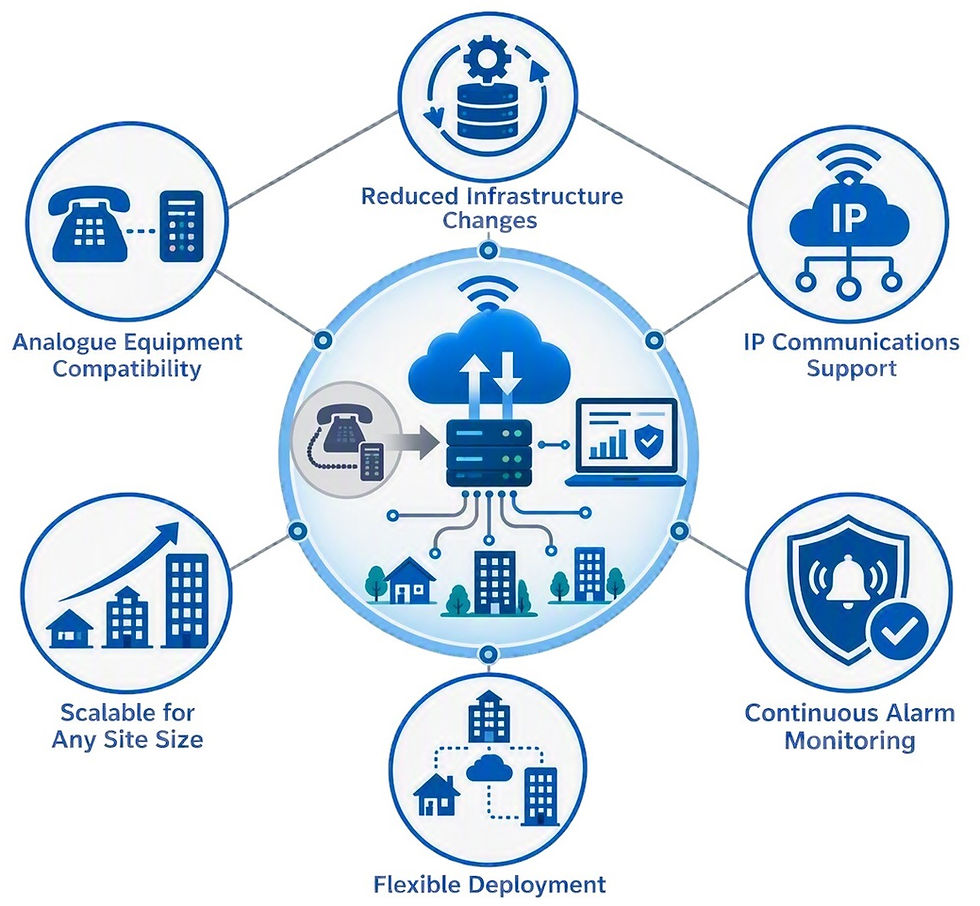
Many established warden call and telecare systems were designed around analogue telephone lines. As the UK moves to all-digital telephone services, these connections cannot simply be assumed to perform in the same way. Alarm signalling, speech quality, line monitoring, and resilience during a power cut all need checking as part of the migration plan.
A digital transition should not be treated as a last-minute line replacement. Housing teams need to know what is connected at every site, how each device communicates, whether it is compatible with the intended digital service, and what happens if mains power or broadband connectivity is lost.
For critical resident-safety services, resilience matters. This may include battery backup within the control equipment, monitored connections, suitable mobile connectivity where appropriate, and a clear process for reporting faults. The correct approach depends on the building and available communications infrastructure. A rural or high-rise location, for instance, may require different connectivity and coverage checks from a small urban scheme.
Network Communication Systems Limited supports customers through this process by assessing existing equipment, maintaining viable legacy components where appropriate, and planning modern digital alternatives. That continuity can help providers avoid the false choice between retaining an ageing system indefinitely and undertaking an unmanaged wholesale replacement.
Designing for Daily Use and Maintenance
An emergency call system is most effective when it is familiar. Residents should understand what each device does, when to use it, and what will happen after they activate it. Staff and scheme managers need equally clear instructions, particularly where alarms are routed to several destinations.
Installation quality has a direct bearing on confidence. Speech units must be audible, call points must be accessible, and labelling must be clear without being alarming or patronising. Communal call points should not be obstructed by furniture, stored mobility equipment, or temporary displays. During refurbishment work, they can be overlooked or disconnected, so system checks should form part of site handover.
Routine testing should cover more than whether an indicator light appears. Test calls should confirm that the correct location is presented, speech is intelligible, the intended recipient receives the alert, and escalation operates as expected. Testing should also include out-of-hours arrangements and, where feasible, loss-of-power scenarios.
Keep an accessible record of tests, faults, repairs, and device allocations. This is useful for managing service quality, identifying recurring issues, and demonstrating that critical systems are being actively maintained. It also prevents confusion when a resident moves flat, returns a pendant, or receives a replacement device.
Integrating Safety with Access Control
Door entry and access control can make emergency response quicker and safer. Where a resident has raised an alarm but cannot reach the door, authorised responders need a lawful, controlled means of entry. Integration can reduce delays, but it must be planned with data protection, safeguarding, and local operating procedures in mind.
Not every scheme needs the same level of integration. A small development with a local warden may need a straightforward managed-key arrangement, while a larger supported-living setting may benefit from auditable access control linked to staff credentials. The priority is that responders can act without compromising residents' security or creating uncertainty over who may enter a home.
Key Questions Before Approving a System
Procurement decisions are stronger when they look beyond the initial equipment price. Ask potential providers how alarms are monitored, what support is available after installation, how faults are diagnosed, and whether replacement parts or component repairs can be provided. Also, ask how the proposed solution will operate through the digital switchover and what resilience is included as standard.
It is worth requesting a clear explanation of responsibilities. The supplier may maintain the system, while the housing provider retains responsibility for resident training, local testing, keyholding, and response arrangements. Those boundaries should be documented, reviewed when staffing changes, and communicated to everyone involved.
A well-specified emergency call system is not simply an asset on a maintenance schedule. It is a practical promise to residents that, when they need help, their home and the people responsible for it are ready to respond.


Comments