
Telecare Equipment for Safer Independent Living

A pendant alarm is only useful if the call reaches the right person, at the right time, with enough information for them to act. That is the practical standard against which telecare equipment should be assessed. For housing providers, care organisations and supported-living operators, the equipment is part of a wider safety service: one that helps residents remain independent while giving teams a clear route to respond when something changes.
The right approach starts with the resident, the property and the response arrangement. It also needs to account for the move away from analogue telephone services. Equipment that has served a scheme reliably for years may need checking, adapting or replacing before a digital transition affects call reliability.
What telecare equipment does
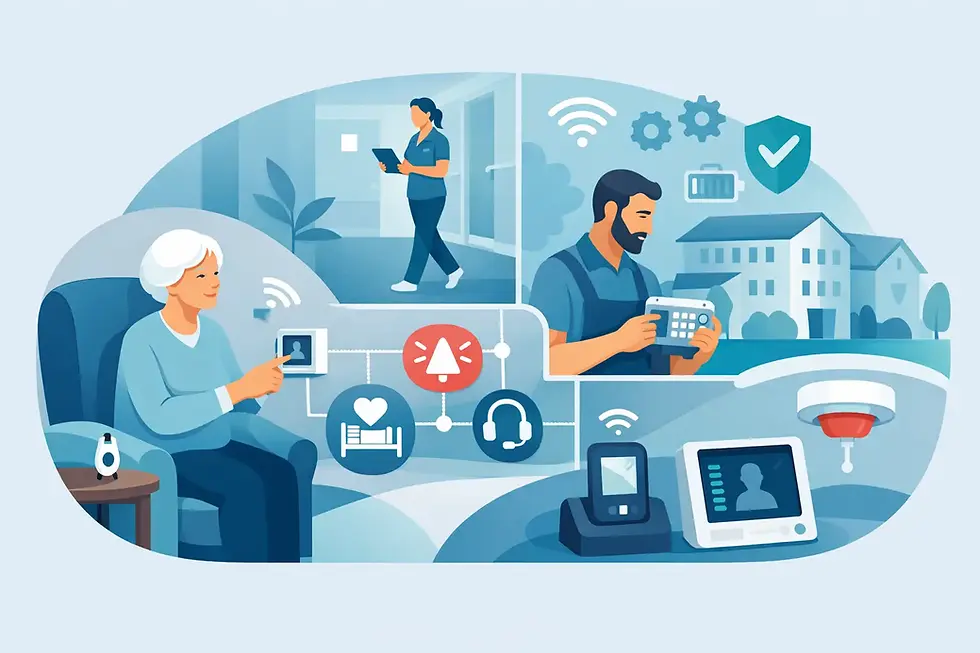
Telecare equipment uses sensors, alarms and communication devices to identify a potential risk and raise an alert. Depending on the system and service model, an alert may go to an on-site team, a control centre, a nominated contact or the emergency services. The aim is not to remove human care. It is to make sure support can be requested or triggered promptly when a resident cannot easily do so themselves.
A typical arrangement combines a base unit or carephone with one or more peripherals. A resident may press a pendant if they have fallen or feel unwell. A smoke detector can raise an alarm even when the resident is asleep or unable to reach a call point. A property exit sensor may help a service understand when a person living with dementia has left a safe area.
The equipment selected should reflect assessed needs rather than a standard package. A mobile resident in sheltered housing may benefit most from a pendant and smoke detection. Someone with epilepsy, diabetes, sensory impairment or a history of falls may require more specific monitoring. In a group-living setting, staff workflows, shared spaces and the location of call points must also be considered.
The telecare equipment that supports everyday risks
The most effective systems are straightforward for residents to use and dependable for the teams who support them. Common devices include personal pendants and wrist-worn triggers, smoke and heat detectors, carbon monoxide detectors, flood detectors, fall detectors, bed and chair occupancy sensors, door contacts and property exit sensors.
Each has a defined role. A pendant provides a deliberate call for help, but it depends on the resident being able and willing to press it. A fall detector can offer additional reassurance, although no automatic device can identify every fall accurately. Flood detection can prevent a small leak becoming extensive property damage, while carbon monoxide detection is a critical safeguard where fuel-burning appliances are present.
This is why telecare should never be specified by device name alone. A fall detector may be appropriate for one resident and intrusive or ineffective for another. A door sensor can support safety without restricting independence, but only where its alert conditions and response plan are clear. Technology must fit the individual and the service, not force either to fit the technology.
The base unit matters as much as the peripheral
Peripherals attract attention because they are visible in the home, but the base unit is the operational centre of the service. It receives alarms, identifies the relevant device and sends the call through an available communication path. It may also provide two-way speech, allowing a control-centre operator or member of staff to speak with the resident and assess what is needed.
When reviewing existing installations, providers should establish how each base unit communicates, whether it is compatible with the intended receiving centre, and how alarm calls are prioritised. Battery condition, radio range, device registration and the quality of two-way speech all affect real-world performance. These are commissioning and maintenance issues, not minor technical details.
Plan telecare around the response, not just the alarm
An alarm is the start of a process. Before equipment is installed, everyone involved should understand what happens next. Who receives the call overnight? Can they speak with the resident? What information do they have about access, keyholding, next of kin and known risks? When is a call escalated, and who records the outcome?
Housing and care teams should also consider the practical conditions within each scheme. Thick walls, large communal areas and outbuildings can affect radio coverage. A resident may move furniture or alter their routine. A pendant can be left on a bedside table, while a sensor may be unplugged if its purpose has not been explained clearly. Good installation includes patient handover, resident instruction and confirmation that the equipment works in the places it will actually be used.
A useful review asks four connected questions:
What risks is this equipment intended to address?
Which alert will be raised, and where will it be received?
Who is responsible for responding at different times of day?
How will the service test, maintain and replace the equipment?
These questions expose gaps early. For example, a detector may be working perfectly, yet the arrangement still fails if the alarm is routed to an unavailable contact or there is no agreed method of gaining access.
Digital transition requires a system-wide check
The BT Digital Switchover has made telecare planning more urgent. Analogue phone services are being withdrawn in favour of digital networks, and older alarm equipment may not operate as intended when connected through a broadband router, adaptor or other conversion arrangement. An apparently successful test call does not always prove that every alarm type, power-loss condition and communication route will perform correctly.
Providers should avoid treating this as a simple line replacement. A full review should identify every connected alarm unit, warden call panel, lift line, door-entry communication path and other safety-critical service. It should then establish the existing connection type, the future network connection, resilience requirements and any work needed at the receiving end.
Digital systems can provide valuable improvements, including clearer management information, modern connectivity and more flexible ways to support residents. They also introduce new dependencies. Mains power, battery backup, mobile signal and network resilience all require consideration. The appropriate solution depends on the building, local coverage, resident needs and the service’s response model.
For larger portfolios, a phased programme is usually more manageable than replacing equipment in reaction to individual line changes. Start with an accurate asset record, identify higher-risk schemes and residents, carry out compatibility checks, then schedule installation and testing with residents and staff properly informed. This reduces disruption and gives teams time to resolve issues before they affect a critical service.
Installation, testing and support protect the investment
Telecare is not fit-and-forget equipment. Sensors need routine testing, batteries need monitoring and records need to show what is installed in each property. Where a resident’s circumstances change, their telecare assessment should change too. A device that was appropriate at the start of a tenancy may no longer provide the right protection months later.
There is also a strong case for retaining repair capability where practical. Replacing every legacy component is not always necessary or cost-effective, particularly where a system remains suitable and is supported by a planned digital upgrade. Conversely, repeated faults, unavailable parts or uncertain compatibility may indicate that replacement is the safer long-term decision.
Working with a specialist provider can bring installation, component repairs, system modernisation and ongoing support into one managed approach. Network Communication Systems Limited supports organisations through these decisions with expertise across connected care, warden call, access technologies and digital-transition planning.
Make resident confidence part of the specification
Residents should know what the equipment does, what it does not do and what will happen when an alarm is raised. Plain explanations are particularly important where a person is new to telecare, anxious about being monitored or concerned that an accidental activation will cause a problem. Testing an alarm with the resident present can turn unfamiliar equipment into a source of reassurance.
The most valuable telecare equipment is rarely the most complicated. It is the equipment that has been properly assessed, installed, tested and supported, with a response service people can trust. When reviewing a scheme, begin with the next resident who may need help and trace the entire route from their alarm to a safe response. That is where sound decisions are made.


Comments