
The PSTN Switch-Off: Protecting Critical Alarm Communications

📞 The UK's telecommunications infrastructure is undergoing a major transition from traditional analogue networks to modern digital communications, creating significant challenges for organisations that rely on phone line-based services. Telecare, warden call, and alarm systems are among the technologies most affected by the PSTN switch-off, making it essential for housing providers, local authorities, care organisations, supported living schemes, and monitoring centres to prepare for the future. These organisations depend on reliable alarm communications to safeguard residents and ensure a rapid response during emergencies.
🔄 As digital migration continues, maintaining service continuity without compromising system performance is a key priority. However, replacing existing analogue infrastructure can be expensive, disruptive, and time-consuming, particularly across large estates and multi-site portfolios. The Universal Digital Communicator (UDC) provides a practical alternative by enabling existing analogue alarm and telecare systems to operate over modern digital networks without the need for immediate system replacement. By bridging the gap between legacy equipment and IP communications, the UDC offers a cost-effective migration path that helps organisations future-proof their services while protecting existing investments. ✅
🎯 In this article, we'll explore how the PSTN switch-off is affecting alarm communications and how organisations can maintain service continuity during the transition:
The impact of the PSTN switch-off
How the UDC works
Key considerations for future planning and digital migration
PSTN Switch-Off Challenges for Alarm and Telecare Systems
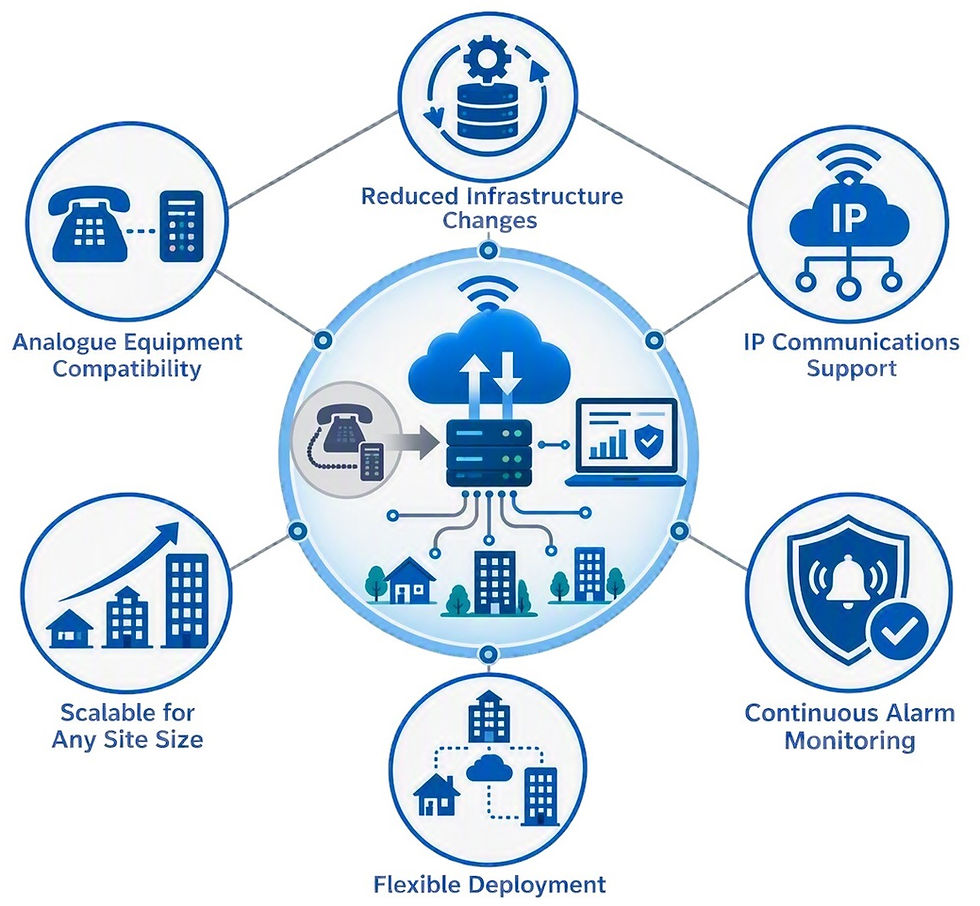
✅ Maintaining compatibility with existing analogue equipment is a key consideration for organisations planning their transition to digital communications. Any solution must also support modern IP networks while minimising the need for extensive infrastructure replacement, helping to reduce both costs and disruption. By retaining much of the existing system infrastructure, organisations can simplify migration projects and avoid unnecessary equipment upgrades. Flexible deployment options allow solutions to be tailored to the specific requirements of different sites, while scalability ensures they can support everything from small residential schemes to large multi-site portfolios. Most importantly, organisations must ensure the continuity of alarm monitoring services throughout the migration process, safeguarding residents and maintaining reliable emergency communications at all times.
How the UDC Works
The Universal Digital Communicator acts as a bridge between legacy alarm systems and modern digital communications networks. By converting analogue alarm signals into IP-based data, the UDC enables organisations to maintain existing systems while preparing for the UK's digital future.
🔄 Simple Five-Step Process
1️⃣ Existing analogue alarm equipment generates an alarm signal.
2️⃣ The UDC receives and processes the signal.
3️⃣ The signal is converted into a digital format.
4️⃣ Secure IP communications transmit alarm data.
5️⃣ Monitoring centre operators receive alarms quickly and accurately.

UDC Solution Components
The Universal Digital Communicator consists of several key components that work together to provide reliable alarm transmission across digital networks. Existing analogue alarm or telecare equipment connects directly to the UDC, which converts alarm signals into a digital format suitable for IP transmission. Data is then securely routed across the communications network to the monitoring centre, ensuring continued service following the PSTN switch-off.

Planning a Successful PSTN Migration Strategy
📞 As organisations prepare for the withdrawal of the PSTN network, maintaining reliable alarm communications remains a critical priority. Many housing providers, care organisations, and local authorities continue to rely on legacy alarm and telecare systems, making it essential to support existing technologies during the transition to digital services. Reliable digital transmission paths must be established to ensure alarm signals are delivered quickly and securely, while minimising disruption to residents and day-to-day operations throughout the migration process. By carefully planning their digital migration strategy, organisations can not only maintain service continuity but also achieve their wider digital transformation objectives, creating a more resilient and future-ready communications infrastructure.

Key Takeaways
📞 The withdrawal of the PSTN network requires organisations across the telecare, warden call, and alarm sectors to take proactive steps to maintain reliable communications. While many existing analogue systems are approaching a critical point in their lifecycle, they can often continue operating effectively when supported by appropriate digital communication technologies. Careful planning and a structured migration strategy can help minimise disruption, reduce costs, and ensure continuity of service throughout the transition. Modern digital communication platforms provide a practical route to long-term operational resilience, enabling organisations to benefit from enhanced connectivity and future-ready infrastructure. To ensure a smooth migration, organisations should assess their current systems, review existing infrastructure, and establish realistic timelines that align with their wider digital transformation objectives. Organisations that begin planning now can minimise disruption, protect vulnerable residents, and avoid unnecessary infrastructure replacement costs. The Universal Digital Communicator offers a practical and scalable path towards PSTN compliance while helping future-proof alarm and telecare services.
🚀 Ready to Future-Proof Your Alarm Communications?
As the UK's PSTN switch-off continues, now is the time to review your alarm and telecare infrastructure. The Universal Digital Communicator (UDC) provides a practical, cost-effective way to maintain service continuity, protect existing investments, and prepare for a fully digital future.
📞 Contact Network Communication Systems Limited today to discuss your requirements and discover how the UDC can support your migration strategy.
🔗link to product: Universal Digital Communicator (UDC)
📧 Email: udc.sales@nsgroup.co.uk
📞 Telephone: 01302 873333



Comments