
Warden Call Systems for Safer Independent Living

A resident presses a call button after a fall. Another needs reassurance during the night. A housing officer must identify an unanswered alarm quickly, establish where it came from and make sure the right person responds. Warden call systems are built for these moments: they provide a dependable route between residents, on-site staff, scheme managers and monitoring services when communication matters most.
For housing providers, local authorities, supported-living operators and care organisations, the system is not simply a piece of equipment. It is part of the service residents rely on to remain safe and confident in their own home. Its design, condition and connection method all affect the quality of that support.
What warden call systems are designed to do
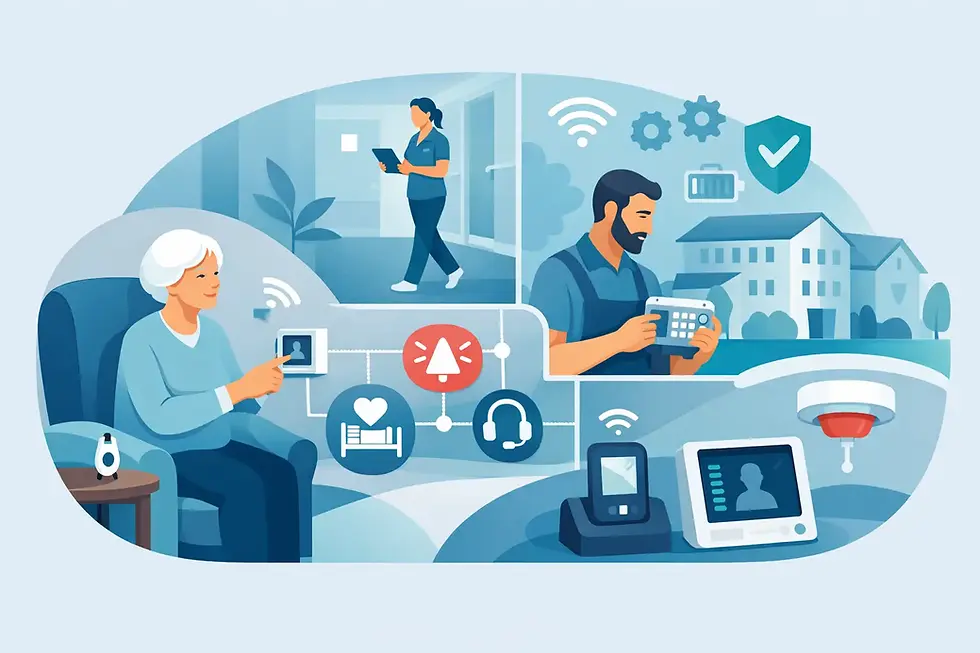
A warden call system enables a resident to request help from within their home or in communal areas. Depending on the scheme and system configuration, calls may be received by an on-site warden, a mobile member of staff, a reception point or an external alarm receiving centre.
The core arrangement usually includes a resident handset or call point, a means of raising an emergency call, and a central control or communication platform. Door entry, communal alarms, smoke detection interfaces and telecare peripherals can also be integrated where appropriate. This gives staff a clearer view of activity across a scheme without requiring every resident need to be physically checked at fixed intervals.
The practical benefit is speed with context. A call should identify the resident or location, alert the intended response team and support a calm conversation where two-way speech is available. In an emergency, that information helps staff decide whether to attend, contact a family member, call the emergency services or escalate through an agreed procedure.
Why system choice affects resident safety
Not every supported housing scheme has the same operating model. A small development with a visiting scheme manager will have different requirements from a large extra-care setting staffed around the clock. The right solution must reflect how people live in the building and how assistance is actually delivered.
For example, residents with mobility difficulties may need easily accessible pull cords in bathrooms and bedrooms, alongside portable pendants that can be worn around the home. Schemes with active communal spaces may need call points in lounges, corridors and gardens. Developments with controlled entrances may benefit from linking door entry and call handling so staff can manage visitor access while responding to resident needs.
There is also a balance to strike between features and usability. A system can offer extensive reporting, integrations and programming options, but residents must still find the call equipment simple and reassuring to use. Clear installation, sensible positioning and regular demonstrations are often as important as the technology itself.
Response arrangements must be clear
Technology raises an alarm, but people and procedures determine what happens next. Providers should establish who receives calls at different times, what response times are expected, how absence or staff handover is covered, and when calls are escalated.
A warden call system should support these arrangements rather than expose gaps in them. If calls are diverted to an off-site centre overnight, for instance, the communication path and resident records need to be accurate. If a scheme relies on roaming staff, mobile alerting and reliable location information become more significant.
Routine testing is essential. It confirms that resident units, pull cords, speech paths, power resilience and alarm routing are functioning as intended. Testing also gives residents and staff confidence that a call for help will be heard when it is needed.
The digital switchover changes the conversation
Many existing warden call and telecare installations were designed around analogue telephone services. As the UK moves away from the traditional analogue network, equipment that depends on older connections may need assessment, adaptation or replacement.
The BT Digital Switchover is not merely an IT project. For supported housing and care environments, it is a safety-critical transition. A system may appear to work during normal conditions but behave differently when connected through new digital services, particularly during a power interruption or network fault. Alarm signalling, voice quality, call routing and backup arrangements all need to be considered.
The sensible starting point is a site-by-site review. Identify every device that uses the existing line, including warden call controllers, carephones, door entry systems, lift emergency communication and any connected telecare equipment. Record how each service is currently monitored, where its power comes from and what resilience is required.
Digital-ready systems can provide a stronger foundation for future service delivery, but the migration route depends on the age of the building, installed equipment and operational needs. In some cases, a carefully planned upgrade is the right answer. In others, legacy components can be maintained while a wider modernisation programme is phased around budgets and resident consultation.
Resilience should be designed, not assumed
Traditional phone services often supplied power through the line. Digital services typically rely on equipment within the property, which may require local mains power. That makes backup power, battery condition and maintenance arrangements especially important for critical communications.
Providers should ask straightforward questions: what happens if the mains supply fails, if the broadband connection is lost, or if an alarm receiving centre cannot be reached? Is there a backup route? How long will essential equipment operate? Who is alerted if a component fails?
There is no single configuration that suits every site. However, documenting these answers makes risk visible and gives facilities, housing and care teams a practical basis for improvement.
Planning a warden call upgrade without disrupting residents
Replacing resident safety systems requires more than selecting new hardware. The work affects people in their homes, staff routines, building access and potentially monitoring arrangements. A well-managed programme reduces avoidable disruption and prevents residents from feeling uncertain about a change designed to support them.
Begin with an accurate survey of the existing installation. This should consider resident handsets, communal equipment, cabling, control panels, network connections, door entry interfaces and any devices that have been added over time. Older schemes often contain a mixture of equipment from different periods, and assumptions can lead to missed dependencies.
Then agree the operational priorities. These may include maintaining an on-site response model, introducing off-site monitoring, improving coverage in communal areas, supporting visual or audible alerting, or combining access control with resident communication. The priorities should be agreed by housing, care, facilities and IT stakeholders rather than treated as a purely technical decision.
Resident communication matters throughout. Give clear notice of visits, explain what will change in plain language and provide a simple demonstration once equipment is installed. Staff should also receive training on call handling, fault reporting, testing and any revised emergency procedures.
During installation, continuity of service is central. A staged approach may allow one area to be commissioned and checked before another is taken out of use. Temporary arrangements should be defined in advance, particularly where vulnerable residents depend on alarms at all hours.
Maintenance protects the original investment
A warden call system should not be left until a fault becomes urgent. Regular preventative maintenance helps identify worn handsets, damaged pull cords, weak batteries, intermittent speech units and communication issues before they compromise resident support.
Component repairs can be valuable where a full replacement is not yet required. They can extend the useful life of established equipment, reduce downtime and support a phased route towards digital infrastructure. That said, repairs should be considered alongside the availability of parts, the wider condition of the system and its suitability for future network services.
Good records are equally useful. Keep details of tests, faults, repairs, battery replacements, system changes and resident equipment allocations. This supports compliance activity, aids fault diagnosis and prevents knowledge being lost when staff responsibilities change.
Network Communication Systems Limited supports organisations through this full lifecycle, from maintaining established installations to planning digital-ready upgrades for supported housing and care settings.
Questions to ask before committing
Before selecting or upgrading a system, decision-makers should be able to answer four practical questions:
Who needs to raise a call, and where are they likely to need help?
Who receives the call at every hour, and what is the agreed escalation route?
Which existing services must connect to the system, including telecare and door entry?
How will the installation remain operational through power, network or equipment failures?
These questions keep procurement focused on resident outcomes rather than specifications alone. A lower initial cost can become expensive if a system cannot support the required response model, cannot be maintained properly or needs premature replacement during the digital transition.
The most effective warden call arrangements are rarely the most complicated. They are the ones residents understand, staff trust and providers can maintain with confidence. Reviewing the system before a fault or network change forces the issue gives organisations time to make measured decisions that protect both continuity of service and independent living.


Comments