
When Do Analogue Alarms Stop Working in the UK?

A resident presses a pendant, a carephone dials out, or a warden call unit raises an alarm. For many housing and care providers, that event still depends on an analogue telephone connection somewhere in the chain. The question, when do analogue alarms stop, is therefore not simply about equipment age. It is about whether every alarm can still reach the right person, first time, when a resident needs help.
When do analogue alarms stop working?
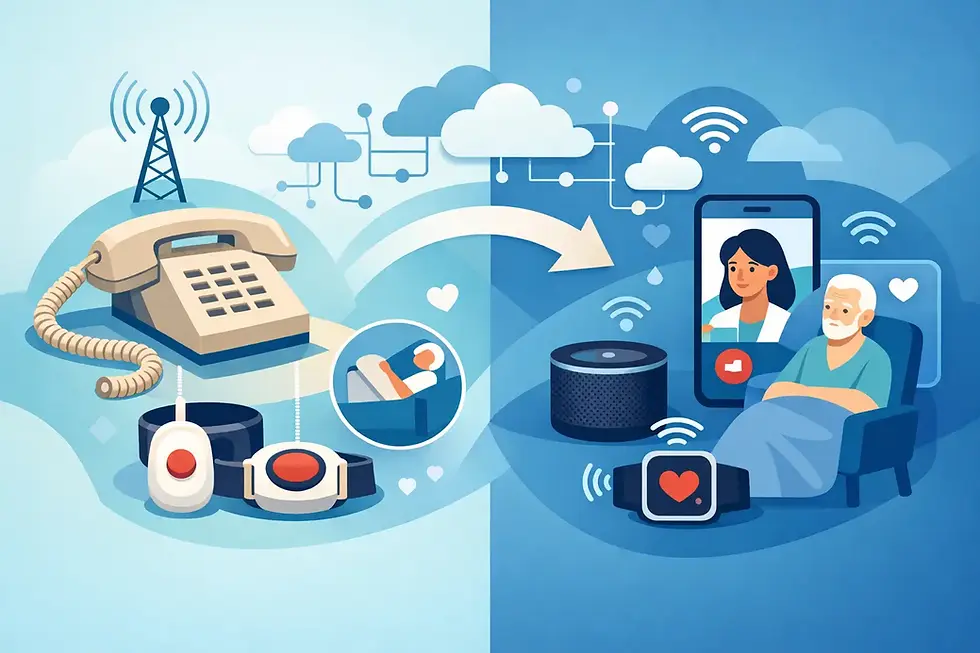
There is no single date on which every analogue alarm unit in the UK will switch off. The significant national milestone is the withdrawal of the traditional public switched telephone network (PSTN), with the UK moving towards digital phone services by January 2027. However, the practical effect is local and phased. Communications providers are migrating customers, services and exchanges to digital infrastructure at different times.
An analogue alarm may continue to operate for a period if it is connected through an adaptor supplied with a digital voice service. That does not mean it has been proven safe or reliable for its intended use. Older alarm communicators were designed to send signalling over a conventional analogue line. Digital voice services convert that signal and carry it over an internet-based network, which can affect compatibility, call set-up and resilience.
For supported housing, extra care and independent-living schemes, the right planning date is not the final national deadline. It is the earliest date on which the line provider proposes to change the service at a particular property. Providers should obtain this information for every site and begin assessment well before a migration appointment is arranged.
What the analogue switch-off means for alarm systems
The phrase ‘analogue alarm’ can describe several different systems. A hard-wired warden call installation may use analogue speech paths. A carephone may dial an alarm receiving centre over a standard telephone line. A dispersed alarm or personal pendant may communicate through a base unit using a telephone socket. Door entry panels, lift lines, emergency call points and intruder alarms can also rely on the same legacy infrastructure.
The key issue is not whether a device looks old, or even whether it has an analogue handset connection. It is how the system communicates from the resident or alarm point to the receiving centre, monitoring service or nominated responder. A modern-looking unit can still depend on a traditional line. Equally, some existing systems can be adapted or upgraded without replacing every device in a scheme.
This requires a site-specific review. Equipment model, software version, wiring, alarm protocol, receiving centre capability and the type of replacement connection all matter. A successful test call from one unit is useful, but it is not enough to prove an entire installation is suitable for a digital service.
Why a simple adaptor is not always the answer
A telephone adaptor, sometimes called an analogue telephone adaptor, can provide a socket for legacy equipment after a digital voice migration. It may be appropriate for certain non-critical applications, but it should not be treated as an automatic solution for life-safety or welfare alarms.
Digital voice equipment normally depends on mains power in the property. During a power cut, a traditional copper telephone line could often continue to provide line power to a basic telephone. A router, adaptor and cordless handset do not have that same inherent resilience. Battery back-up may be available, but its capacity, maintenance and actual operating time must be understood.
There can also be issues with the way legacy alarm tones travel across a converted connection. The system may appear to dial successfully but fail to transmit the full alarm message reliably. Speech quality, line supervision and automatic retries may perform differently. These are operational matters, not technical details to leave until the day of migration.
Mobile signal is another consideration where a mobile telecare solution is proposed. It can offer a strong alternative to a fixed line, particularly where it is professionally installed, monitored and designed for the application. Yet coverage must be assessed inside the individual dwelling and in the precise location where the unit will be used. Signal strength outside a building is not a sufficient test.
The risks are greater in supported environments
For an ordinary domestic telephone, a short interruption during a changeover is inconvenient. In a scheme where residents use pendant alarms, pull cords or speech units to call for assistance, it can create a safeguarding risk. The consequences are particularly serious where people may have limited mobility, cognitive impairment, sensory loss or no alternative way to summon help.
Housing providers also need to consider the wider service model. Does an alarm go to a 24-hour alarm receiving centre, an on-site scheme manager, a concierge desk or a family member? Is a response team relying on accurate location information and alarm type? Can the service identify a failed communication path before a resident tries to raise an alarm?
A replacement solution should support the required level of monitoring and escalation, rather than merely replicate the dial tone. It should also be considered alongside fire safety procedures, emergency planning and staff response arrangements.
A practical migration programme for warden call and telecare
A controlled transition starts with visibility. Build an asset record for each scheme, covering carephones, warden call controllers, dispersed alarm units, pendant receivers, lift auto-diallers, door entry communications and any other equipment using telephone lines. Record the line number, provider, location, device model, purpose and monitoring destination.
Confirm the local migration date
Ask the communications provider when each line or service will move to digital voice. Do not assume that one exchange date applies across a portfolio. Multi-site organisations can have different providers, contracts and migration schedules, including lines held by managing agents or service partners.
Identify critical alarm paths
Separate welfare and life-safety communications from general telephony. A communal office line may be relatively straightforward to replace. A carephone serving dozens of residents needs a more rigorous design, testing and contingency plan. Include seldom-used devices, such as plant-room emergency phones and lift alarms, because their failure may only become visible during an incident.
Decide whether to adapt, upgrade or replace
Some systems can be retained with approved digital connectivity and suitable resilience. Others need a communicator upgrade, while ageing installations may be better replaced with a fully digital warden call or telecare platform. The best option depends on condition, supportability, expected service life and the cost of maintaining workarounds.
A short-term adaptor can reduce immediate disruption, but it may add complexity and leave an organisation with equipment approaching end of support. A planned digital upgrade can improve reporting, remote management and future compatibility, but it requires capital planning, resident communication and installation time. The choice should be based on risk and whole-life value, not just the first cost.
Test the full journey, not only the device
Testing should confirm that an alarm is raised, transmitted, correctly identified at the receiving point and responded to through the agreed process. Test different alarm types where relevant, including pendant activations, pull-cord calls, smoke or environmental alerts and speech communication. It is sensible to test during normal operating conditions and after any change to routers, power arrangements or mobile connectivity.
Keep a documented record of results, faults and corrective actions. This provides an auditable basis for sign-off and helps operational teams understand what has changed at the scheme.
Prepare residents and staff
Residents need clear reassurance in plain language, particularly if a visit is required in their home or their equipment will look different afterwards. Staff, wardens and response teams should know how to recognise faults, perform basic checks and follow contingency procedures. A migration is more reliable when technical installation and service delivery are planned together.
Digital systems are not all the same
A digital transition does not require a single technology choice across every property. IP-connected systems can suit schemes with managed network infrastructure and appropriate power resilience. Cellular telecare may be a practical option for dispersed properties or where fixed-line arrangements are changing. Hybrid approaches can support phased upgrades where a full replacement programme is not yet possible.
What matters is that the chosen system is designed for the environment. It should provide the required alarm handling, work with the monitoring arrangement, remain supportable and have a clear approach to power and connection failure. Where communal access control, door entry and resident communication systems interact, the design should consider those services together rather than as isolated projects.
Questions to ask before a line is migrated
Before agreeing to a digital voice appointment, establish whether every connected alarm or emergency device has been identified and assessed. Confirm who is responsible for testing, what resilience is in place during a power failure, and whether the alarm receiving centre supports the proposed signalling method.
Also ask what happens if a migration fails. There should be a named technical contact, a defined escalation route and a workable temporary arrangement for residents whose alarm service cannot be verified. These details are especially valuable outside office hours, when a minor communications fault can become an operational emergency.
Network Communication Systems Limited supports housing and care organisations with legacy-system assessment, component repairs and planned digital transition work. The aim is not simply to remove analogue lines, but to maintain dependable resident communication throughout the change.
The most useful next step is to review one representative scheme now, from pendant press to responder action. It will reveal whether an apparent telephone-line change is actually a wider safety-system decision - and give your organisation time to make that decision properly.


Comments