
BT Digital Switchover: Protect Critical Systems
- Network Communication Systems

- 4 days ago
- 6 min read
Updated: 2 days ago
A resident presses a pendant, calls from a communal handset or uses an emergency pull cord because they need help now. That signal must reach the right person every time. The BT Digital Switchover changes the network beneath many of those services, making it a resident-safety and business-continuity issue rather than a routine telephone upgrade.
For housing providers, care organisations and supported-living operators, the priority is clear: identify every system that depends on an analogue line, establish whether it will work on an all-digital service and put a tested replacement or migration plan in place. Waiting for a line to stop working is not a safe or cost-effective strategy.
What the BT Digital Switchover means for supported housing
The traditional Public Switched Telephone Network (PSTN) is being retired and telephone services are moving to digital, internet-based connections. In practice, this means that equipment once connected directly to a conventional phone socket may no longer operate as intended, even where there appears to be a working dial tone through a broadband router.
The effect varies by site. A modern, correctly configured digital carephone may be ready for the change. An older warden call panel, lift autodialler, alarm communicator, intercom or door-entry system may rely on the characteristics of an analogue line that are not reproduced reliably by a digital adaptor. Fax machines, payment terminals, fire and intruder alarm signalling, boiler monitoring and emergency lines can also be affected.
This is why a simple line conversion should not be treated as proof of compatibility. A device may place a test call but still fail under particular conditions, such as a power interruption, poor mobile coverage, a router restart or a delay in the broadband connection becoming available. For critical resident communications, those conditions matter.
Start with a complete service inventory
A reliable digital-transition programme begins with a site-by-site inventory. This needs to go beyond the main communal system and record every item connected to, or dependent on, a telephone service.
For each device, establish its location, purpose, manufacturer, model, age, connection type and the number it calls. Record whether it is safety-critical, who receives its calls, whether it has battery backup and who maintains it. Include equipment in plant rooms, lifts, roof spaces, gatehouses and vacant properties as well as offices and communal areas.
This exercise often reveals hidden dependencies. A lone-worker line may be connected through an old extension. A door-entry panel may share a service with a communal carephone. A legacy alarm may have been installed by a contractor no longer involved with the building. These are manageable issues when identified early, but difficult to resolve under the pressure of an impending migration date.
It is also sensible to check the condition of the wider infrastructure. Ageing internal wiring, poorly labelled cabinets and unsupported control panels can complicate any upgrade. In some cases, retaining an analogue-style connection temporarily may be possible, but it should not become a substitute for a longer-term plan.
Assess compatibility, not assumptions
The central technical question is not whether a device can be plugged into a router. It is whether the complete communication path performs reliably in real operating conditions.
Ask the system supplier or specialist provider for written confirmation of compatibility with the proposed digital service. This should cover alarm and speech calls, identification of the calling device, call routing, remote programming where used and expected behaviour during power or network failure. If a device uses protocols designed for analogue signalling, its performance must be assessed carefully.
Warden call and telecare systems deserve particular attention. A resident may be unable to explain their location or condition during an emergency, so the receiving centre needs accurate information and a dependable speech path. Systems should be configured to identify the scheme, dwelling or alarm point correctly. Any change to telephone numbers, network routing or monitoring arrangements should be checked against the receiving centre's requirements.
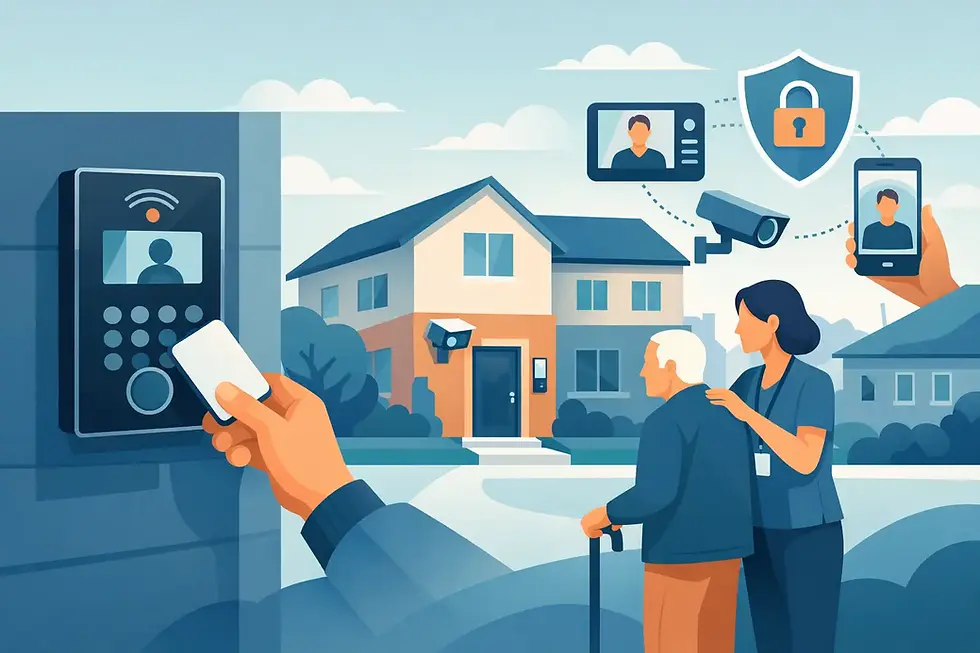
Door entry can present a different but equally practical risk. If residents use a telephone handset or connected service to speak with visitors and release doors, a failed migration could affect daily access, visitor management and building security. The correct approach depends on the existing installation. Some systems can be reconfigured; others are better replaced with IP-capable door entry or access control designed for the building's future needs.
Plan for power resilience from the outset
Traditional telephone lines commonly continued to provide a basic service during a local mains power cut. Digital phone services depend on powered equipment, including routers, optical network terminals and sometimes local adaptors. That changes the resilience calculation.
Assess what must continue to operate during a power failure, for how long and what backup arrangement is appropriate. A small uninterruptible power supply may support selected equipment for a limited period, but its capacity, battery condition and maintenance responsibilities need to be understood. It may not be adequate for an entire communications cabinet or a prolonged outage.
Where mobile connectivity is part of the solution, survey signal strength in the actual locations where equipment will operate. A strong signal outside the building does not guarantee reliable service in a basement plant room, a sheltered flat or a rural scheme. Consider network resilience too: one connection, one router and one power source can create a single point of failure.
There is no single resilience model for every property. A small independent-living scheme and a large extra-care development have different operational risks. The appropriate design should reflect resident needs, staffing arrangements, response procedures and the consequences of a lost connection.
Deliver migration as a controlled change
Once the required solution is known, schedule the work as a controlled operational change. Avoid moving all services at once without a fallback plan, especially at occupied sites supporting vulnerable residents.
Notify residents, scheme staff, monitoring centres, contractors and internal helpdesks in clear language. Explain what will happen, when access may be needed and how to report a concern. For communal systems, provide staff with temporary procedures if an outage occurs during installation or testing.
Testing must be more than a single successful call. Test each alarm type and each relevant dwelling or communal point. Confirm that calls reach the correct destination, the right location details are displayed and two-way speech is clear. Test door release where applicable, along with fault reporting, battery backup and recovery after a deliberate power or network interruption where it is safe to do so.
Keep a commissioning record showing the tests completed, results, outstanding actions and handover contacts. This creates an auditable record for property teams and gives future maintenance engineers a sound starting point.
Use the switchover to improve the wider estate
The BT Digital Switchover can expose systems that are already near the end of their useful life. That is not always bad news. It gives organisations an opportunity to replace isolated fixes with a considered digital strategy.
A planned upgrade may bring clearer alarm reporting, improved remote support, better integration between telecare and warden call, and more suitable access control for a changing resident profile. It can also reduce the cost and disruption of repeated emergency repairs to obsolete equipment. The trade-off is that a wider modernisation project requires capital planning, resident engagement and careful specification.
Network Communication Systems Limited can help organisations assess legacy equipment, maintain essential services during transition and specify digital solutions suited to supported housing, care and residential environments. The most suitable route may be a targeted adaptation, a phased replacement or a full system renewal. The right choice depends on the condition of the installed base and the operational demands of each scheme.
Give every scheme a clear owner
Digital transition work can fall between telecoms, housing management, repairs, care and IT teams. Assign a named owner for each site and make responsibility explicit for the system, the connection, the monitoring arrangement and the resident communications process.
Review the plan regularly as provider migration dates are confirmed or changed. Keep records current when a line is ceased, a router is replaced or a monitoring number changes. Most importantly, continue testing after handover. A system that worked on installation day still needs planned maintenance, battery checks and prompt investigation of faults.
The best time to protect a resident communication system is before the network changes beneath it. A measured survey, an evidence-based compatibility assessment and properly witnessed testing give housing and care teams the control they need to move forward with confidence.
🔗link to product: Digital Transition / Universal Digital Communicator (UDC)
📧Email sales@nsgroup.co.uk
📞Telephone: 01302 873333


Comments