
What Good Supported Housing Telecare Looks Like
- Network Communication Systems

- Aug 27
- 6 min read
Updated: 2 days ago
A resident presses a pendant, pulls a bathroom cord or uses a wall-mounted call point because something has changed. They may have fallen, feel unwell, be distressed or simply need reassurance. Supported housing telecare must make that moment straightforward: the alert needs to reach the right place, be understood quickly and receive an appropriate response.
For housing providers, this is not solely a question of choosing an alarm unit. It is about maintaining a dependable communication route between residents, on-site teams, mobile staff, alarm receiving centres and emergency services where required. As analogue telephone services are withdrawn, it is also about ensuring that critical calls continue to work on the digital networks replacing them.
Supported Housing Telecare Starts With the Resident
The strongest systems are designed around the people who will use them, rather than around a product specification alone. Residents may be older, living with a long-term condition, managing reduced mobility, or receiving support for learning disabilities or mental health needs. Some will use a pendant every day; others may never activate it but gain confidence from knowing it is there.
That confidence relies on simplicity. A resident should know how to call for help without needing to navigate a complicated device or remember a sequence of actions. Equipment must also suit the environment. A portable pendant may be appropriate in an independent-living flat, while a fixed call point, pull cord or specialist sensor may be more suitable in a communal bathroom, corridor or supported-living setting.
Telecare is most effective when it supports independence without creating false reassurance. A device cannot replace a properly considered support plan, clear response arrangements or regular resident contact. It can, however, provide an important safety layer and give teams earlier notice when help may be needed.
The System Behind the Call Matters
A telecare installation is a connected service, not a collection of individual devices. At its centre sits a digital carephone, warden call controller or grouped communication system that receives alerts and passes them to nominated responders. The right configuration depends on how the scheme operates.
In a traditional sheltered housing development with a scheme manager, alerts may be directed first to on-site staff during working hours and to an alarm receiving centre at other times. In dispersed or visiting-support models, the route may be different. A care organisation may need calls to reach a central monitoring team, while a local-authority service may operate its own response arrangements. There is no single correct call path, but there must be a documented one.
It should be clear who receives each alert, what information they can see or hear, what happens when the first contact cannot respond, and how incidents are recorded. A system that makes a call but offers no reliable escalation route leaves too much to chance.
Voice Communication and Clear Identification
Two-way speech remains central to many supported housing telecare arrangements. It enables a responder to assess the situation, reassure the resident and decide whether to contact a family member, support worker, emergency service or other responder. Good audio quality matters, particularly where residents have hearing difficulties or where a device is being used from another room.
Equally, responders need confidence about where the call has originated. Accurate resident records, location details and unit identification help avoid delay. Changes in tenancy, next-of-kin contacts, keyholder arrangements and support plans should be reflected in the system promptly. This administrative discipline is every bit as important as the hardware.
Selecting Peripherals for a Genuine Need
Pendant alarms are familiar, but they are only one part of telecare. Smoke, carbon monoxide and heat detectors can provide additional warning. Flood detectors, property-exit sensors, bed or chair occupancy devices, medication prompts and epilepsy sensors may also have a place in an assessed package.
The deciding factor should be a recognised risk or support need, not a desire to add technology for its own sake. Too many alerts can lead to alarm fatigue for residents and staff. Too few may leave a significant gap in protection. A sensible approach reviews the resident’s needs, the layout of the property, the response capability available and the potential consequences of an alert.
Preparing Supported Housing Telecare for Digital Networks
The BT Digital Switchover changes a fundamental assumption behind many older telecare systems: that a conventional analogue telephone line will continue to carry alarms and voice calls as it has for decades. Digital voice services can operate differently, particularly during a local power failure or where broadband equipment and mobile connectivity are involved.
This does not mean every existing installation must be replaced immediately. It does mean housing providers should establish exactly what equipment they have, how it connects and whether it has been tested on the service that will replace the analogue line. Assumptions based on a successful ordinary phone call are not enough. Telecare signalling, call set-up, speech quality and power-loss behaviour all need consideration.
A structured audit should identify carephones and warden call systems, connected peripherals, communal equipment, telephone lines, broadband services, mobile signal conditions and the intended alarm receiving route. It should also identify vulnerable residents whose safety could be affected by an unplanned service interruption.
Digital-ready equipment can offer stronger communication options and support modern monitoring arrangements, but the migration must be managed carefully. Providers need an installation plan, resident communication, testing before and after changeover, clear fault reporting and a contingency process if connectivity is lost. In buildings with poor mobile coverage or complex communal infrastructure, the answer may require more detailed site design.
Resilience Is a Design Requirement
Power resilience is particularly important. Older analogue services could often continue to support a basic telephone during a power cut. Digital services may depend on mains-powered routers, optical network terminals, local controllers or other equipment. The available battery back-up, its expected duration and the actions required once it is exhausted should be understood before a service is placed in use.
Resilience also includes network choice, equipment location and maintenance. A controller installed in an inaccessible cupboard, a depleted backup battery or a poorly positioned aerial can undermine an otherwise suitable system. Regular testing should confirm that devices communicate correctly, alerts reach the expected destination and staff know how to respond when they do not.
Integrating Safety, Access and Day-to-Day Operations
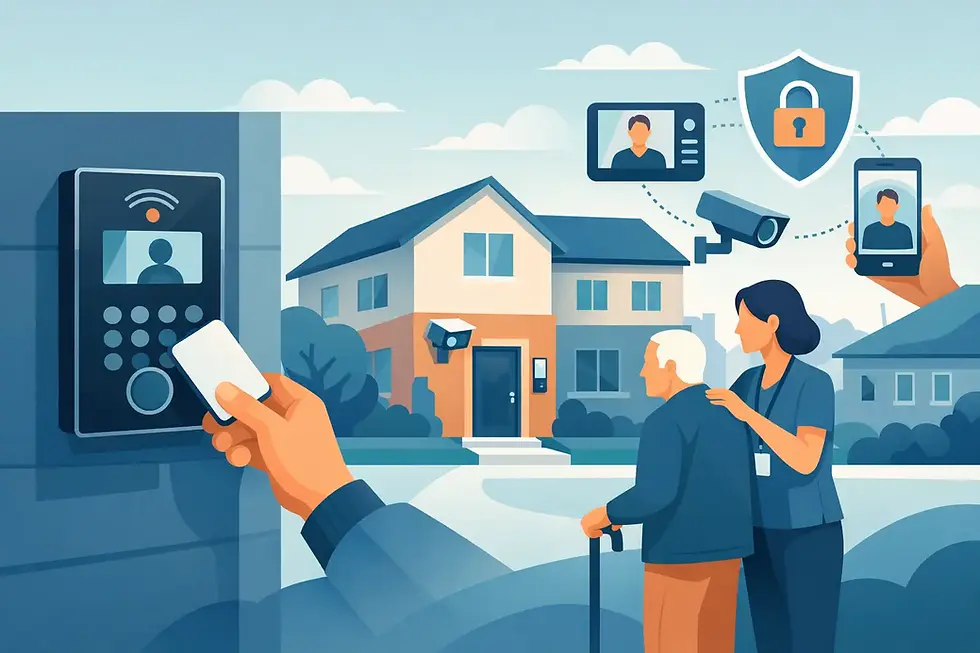
Supported housing systems are often stronger when telecare, door entry and access control are considered together. A resident who has called for help may need responders to gain authorised access quickly. At the same time, providers need to protect communal buildings and residents from unauthorised entry.
Integration should be purposeful rather than automatic. Access arrangements must respect privacy, tenancy rights and local operating procedures. However, a well-planned combination of secure door entry, controlled staff access and clear emergency protocols can reduce avoidable delays and make daily management easier.
Facilities and housing teams also need practical visibility. They should know which devices require battery replacement, which units are offline, whether a repair is outstanding and whether a change in occupancy needs a system update. Service continuity is not delivered at installation alone. It depends on repairs, preventative checks, accurate records and access to specialist support when faults occur.
Questions to Ask Before Upgrading
Before committing to a replacement or modernisation programme, decision-makers should be able to answer a few operational questions. What risks does the current system address, and where are its limitations? Which residents or schemes have the greatest exposure to the digital switchover? Who responds to calls at every hour, and are those arrangements tested? What level of power and communications resilience is needed? Finally, how will equipment be maintained over its life?
The answers will vary between a small independent-living scheme and a large portfolio of sheltered or supported properties. A phased programme may be appropriate where existing equipment remains serviceable and can be proven compatible. In other cases, ageing hardware, unsupported components or unreliable communications may make earlier replacement the safer option.
Network Communication Systems Limited works with housing and care organisations on both sides of this decision: maintaining and repairing established systems where appropriate, while providing digital-transition planning and modern telecare solutions where change is needed.
The right supported housing telecare arrangement gives residents a clear way to ask for help and gives operators confidence that the call will not be lost in the technology. That confidence is earned through careful design, tested response arrangements and an ongoing commitment to keeping every critical connection working.
🔗link to product: Product Catalogue
📧Email sales@nsgroup.co.uk
📞Telephone: 01302 873333


Comments