
What is a warden call and how does it work?
- Network Communication Systems

- Aug 25
- 6 min read
Updated: 2 days ago
A resident presses a pendant after a fall, uses a pull cord in the bathroom or activates a wall-mounted call point. Within seconds, the alarm is sent to a person or service able to respond. That is the practical answer to what is a warden call: a communications and safety system designed to help residents summon assistance when they need it.
For housing providers, supported-living operators and care organisations, a warden call system is more than an alarm button. It is part of the safety infrastructure of a scheme. It gives residents a direct route to assistance, helps staff understand where an alarm has originated and supports an appropriate response, whether that is from an on-site team, a mobile responder, a monitoring centre, a family contact or the emergency services.
What is a warden call system?
A warden call system connects residents with support through fixed equipment, portable devices and a central communication point. It is commonly found in sheltered housing, extra-care housing, supported living, retirement developments and some care environments.
The name comes from the traditional role of the scheme warden. While many schemes no longer have a resident warden on site around the clock, the need for reliable resident-to-support communication remains. Modern systems are therefore designed around the response model in place at each property, rather than relying on one particular staffing arrangement.
When an alarm is raised, the system identifies the caller and, where appropriate, their location. Staff or monitoring operators can then establish what has happened, often through speech communication, and arrange the right help. A call may be handled locally within the building, remotely by an alarm receiving centre, or through a combination of both.
A warden call should not be confused with a fire alarm, intruder alarm or nurse call system, although it may sit alongside each of them. Its principal purpose is to support the wellbeing, independence and day-to-day safety of residents who may need reassurance or assistance.
How a warden call works in practice
The exact operation depends on the system design, but the process is straightforward. A resident activates a device. The signal reaches the scheme controller, carephone or digital hub. The call is then directed to the agreed response point, with relevant resident and location information available to the person handling it.
In a flat, a call may be made using a hard-wired call point with a press button and pull cord. A resident may also wear a pendant alarm around the neck or wrist, allowing them to call for help from elsewhere in the home. In communal areas, call points can provide a way to request assistance if a resident becomes unwell or feels unsafe.
Where speech capability is installed, the responder can speak directly to the resident through the home unit, allowing them to assess the situation. A calm conversation can establish whether the person needs urgent medical help, a member of staff, a relative or simply reassurance. This matters because not every activation has the same level of urgency.
In larger schemes, the system may also display alarm locations on staff handsets, desktop equipment or annunciator panels. This helps teams reach the right flat or communal area quickly, rather than losing time trying to identify the source of a call.
Core equipment in a warden call installation
A system is usually built from several connected elements. The combination should be selected to match the property, resident profile and staffing arrangements.
A resident home unit or carephone provides the main communication point within each dwelling. It may include a call button, loudspeaker and microphone, as well as connections for additional telecare devices. Wall-mounted call points and bathroom pull cords give residents accessible ways to raise an alarm in locations where falls and medical incidents may occur.
Portable pendant alarms are particularly valuable for people who are mobile within their flat or use communal spaces. Other telecare peripherals can add further protection. These may include smoke, heat, carbon monoxide, flood, bed occupancy, medication or epilepsy sensors, depending on assessed need.
At scheme level, a central controller or digital platform manages calls and routes them to the required destination. Staff may use dedicated handsets or mobile devices to receive alerts. A reliable power arrangement and battery back-up are also essential considerations, as a system must continue to protect residents during a local power interruption.
Warden call, telecare and door entry: where each fits
These terms are sometimes used interchangeably, but they describe different parts of a connected safety and communication strategy.
A warden call system provides the route for a resident to call for assistance. Telecare refers to sensors and devices that can automatically raise an alert when they detect a risk or change in routine. For example, a heat detector may signal a possible fire, or a fall detector may generate an alert without the resident having to press a button.
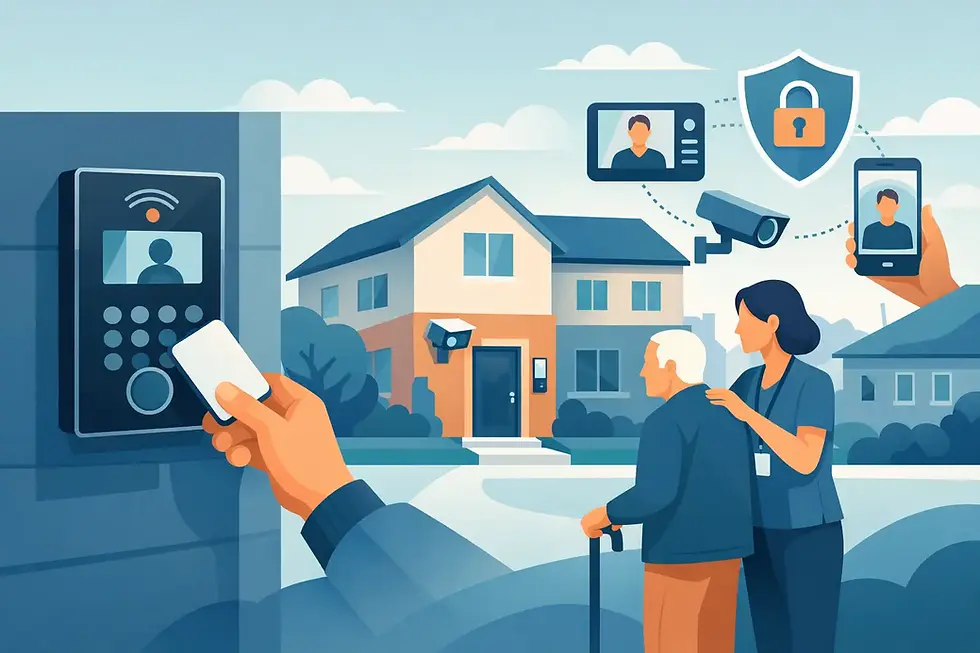
Door entry and access control manage who can enter a building or restricted area. They can support resident safety and help staff manage visitors, contractors and deliveries, but they do not replace a warden call system. In a well-planned scheme, these technologies work alongside one another while retaining their distinct roles.
What housing providers should consider
The right solution is not simply the one with the most devices. It is the system that matches the needs of residents and gives the organisation a dependable response process.
Start with the response model. Is assistance provided by on-site staff, a visiting scheme manager, a remote monitoring centre or an out-of-hours service? The warden call design must direct alarms to people who can act, at the times residents may need support. There is little value in an alarm route that is unclear, unstaffed or dependent on equipment that is no longer maintained.
The building itself also matters. Older sheltered schemes may have legacy wiring, ageing controllers and equipment that remains serviceable but needs careful assessment. New developments may be better suited to digital-first infrastructure with the capacity to support future telecare, mobile working and building-management requirements. In either case, coverage, device placement, communal areas, accessibility and maintenance access all need consideration.
Resident needs should inform the specification too. Some residents may need a simple fixed call point; others benefit from wearable devices, automated sensors or enhanced speech communication. Clear, familiar equipment is often as important as technical capability. Residents must understand how and when to use it, and staff need confidence in responding to alarms and testing equipment.
The digital transition and the end of analogue lines
Many existing warden call and telecare systems were designed around traditional analogue telephone services. As the UK moves away from the Public Switched Telephone Network, housing providers need to understand whether their current equipment, alarm signalling and monitoring arrangements will continue to operate as intended.
This is not only a question of replacing a phone line. Digital services can behave differently during a power cut, and some legacy alarm devices may not communicate reliably over newer network connections without suitable adaptation or upgrade. Testing is essential, especially where an alarm call is critical to a resident's safety.
A planned digital transition allows organisations to review the whole pathway: the resident device, in-building network, call routing, monitoring endpoint, power resilience and maintenance arrangements. It also provides an opportunity to remove unsupported equipment and introduce technology that is easier to manage over the long term.
For some schemes, a phased upgrade is the most practical route. For others, particularly where systems are near end of life or repairs are becoming frequent, a full modernisation may offer better value and lower operational risk. The appropriate approach depends on the condition of the existing installation, the available budget and the urgency of the digital change.
Reliability depends on support as well as equipment
A warden call system is only dependable when it is inspected, tested and maintained properly. Routine checks should confirm that call points, pendants, speech units, alarm routing, batteries and any connected telecare peripherals are operating as expected. Fault reporting should be clear, and staff should know what to do if a device is damaged, lost or activated in error.
It is also sensible to consider repairability. In some cases, replacing a component can extend the useful life of an existing system while a wider upgrade is planned. In others, repeated faults are a sign that a more strategic replacement is needed. An experienced specialist can help distinguish between a practical repair and a false economy.
Network Communication Systems Limited supports organisations through both legacy repairs and digital system upgrades, helping schemes maintain service continuity while preparing for future requirements.
The most effective warden call arrangements are those residents can use without hesitation and staff can rely on without uncertainty. Reviewing the system before a fault, analogue service change or change in resident need gives providers time to protect continuity of care rather than reacting under pressure.
🔗link to product: Product Catalogue
📧Email sales@nsgroup.co.uk
📞Telephone: 01302 873333


Comments